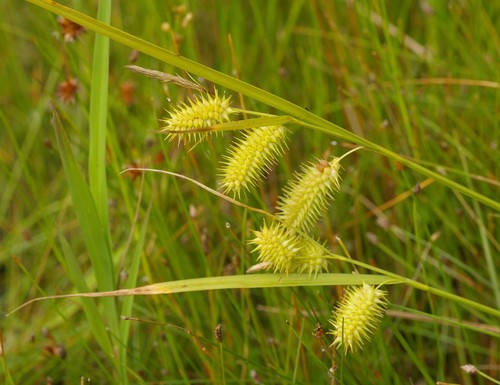
bottlebrush sedge
Carex hystericina
The bottlebrush sedge is the punk-rocker of the plant world, sporting spiky, porcupine-like seed heads that define the North American wetland landscape.
Quick Identification
Size
Grows 30–100 cm (12–39 in) tall; seed spikes are 2–6 cm (0.8–2.4 in) long.
Colors
Bright lime-green to yellowish-green foliage; seed heads turn from green to straw-brown as they mature.
Key Features
- Distinctive cylindrical seed spikes resembling a bottle brush or porcupine
- Long, needle-like awns extending from the seed husks (perigynia)
- Strongly three-angled stems (triangular in cross-section)
- Clump-forming growth habit with narrow, grass-like leaves.
When You’ll See Them
Geographic range
Where Does the bottlebrush sedge Live?
The bottlebrush sedge is broadly native to North America, with a massive footprint stretching from southern Canada across nearly the entire contiguous United States. It flourishes in the temperate heartlands of the Midwest and Northeast but extends its reach south into Mexico and even into the Caribbean island of Jamaica. While primarily a wild wetland resident, it has become increasingly popular in suburban ecological restoration projects across its native range.
Basemap © OpenStreetMap contributors
Behavior
Bottlebrush sedge is a perennial wetland plant that plays a structural role in North American ecosystems. Unlike many decorative grasses, it thrives in saturated soils, forming dense, fountain-like clumps that help stabilize shorelines and filter runoff. It is wind-pollinated, releasing its pollen in late spring to early summer before developing its iconic spiky seed heads.
As a foundational species, it interacts with wildlife by providing essential nesting material and cover for marsh-dwelling birds and amphibians. While it doesn't move on its own, it is a hub of activity; its seeds are a food source for waterfowl, and its dense root system creates micro-habitats for aquatic insects. In a backyard setting, it is a favorite for rain gardens and pond edges, where it remains resilient against seasonal flooding.
EverydayEarth exclusive
Camera Tips
Capturing the bottlebrush sedge on a backyard camera is best achieved through time-lapse photography rather than traditional motion triggers. Set your camera to take a photo every 30 to 60 minutes during the daylight hours from late May through July. This allows you to create a stunning visual record of the seed heads (perigynia) as they inflate and develop their long, prickly awns. For the best perspective, mount your camera on a short stake roughly 18 inches off the ground, tilting it slightly upward to capture the texture of the spikes against the sky.
Since this species thrives in wet areas, positioning is everything. Place your camera near a rain garden or a damp corner of your yard where the sedge is most vibrant. To capture the wildlife that interacts with the plant, use a high-sensitivity motion setting; waterfowl, sparrows, and muskrats are frequently drawn to these clumps for food and shelter. Use a macro lens or a camera with a short focal length if possible, as the intricate 'teeth' on the seed heads are the plant's most striking visual feature.
Lighting is your best friend when filming sedges. Aim the camera so that the plant is backlit during the morning or late afternoon golden hours. The low sun will catch the translucent edges of the spiky seed heads, making them appear to glow. Be mindful of moisture; if your camera is placed in a boggy area, ensure you use a fresh desiccant pack inside the housing to prevent the lens from fogging up in the high-humidity environment that bottlebrush sedge loves.
Similar Species
Species that look similar or are commonly confused with bottlebrush sedge.
Frequently Asked Questions
Record bottlebrush sedge at your habitat
Connect a camera to start building your own species record — AI identifies every visitor automatically.