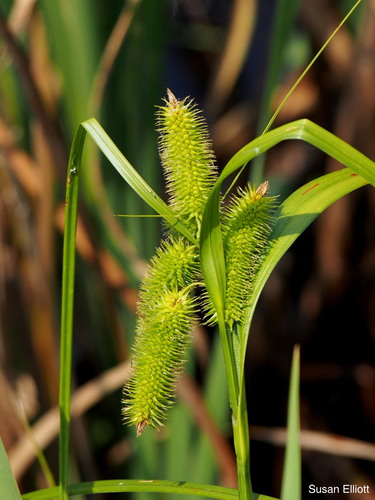
bristly sedge
Carex comosa
With its iconic 'bottlebrush' flower spikes and sturdy triangular stems, the bristly sedge is a cornerstone of North American wetlands. It provides essential habitat for everything from rare marsh birds to shimmering dragonflies.
Quick Identification
Size
Stems reach 50–120 cm (20–48 in) in height; flower spikes are 2–5 cm (0.8–2 in) long.
Colors
Bright lime green to deep emerald foliage; flower spikes turn from light green to a golden-brown or tan as they mature.
Key Features
- Distinctive 'bottlebrush' cylindrical spikes
- Triangular stems typical of the sedge family
- Long, reflexed (downward-pointing) bristles on the fruits
- Leaf-like bracts that extend significantly beyond the flower clusters
When You’ll See Them
Geographic range
Where Does the bristly sedge Live?
The bristly sedge is a true North American native, boasting a massive range that spans from the southern provinces of Canada down through the majority of the United States and into parts of Mexico. It is most frequently encountered in the glaciated regions of the Midwest and the Northeast, as well as along the Atlantic Coastal Plain, where wetland habitats are abundant. While it is less common in the arid interior of the continent, it reappears in significant populations along the Pacific Coast and in mountain wetland pockets.
Basemap © OpenStreetMap contributors
Behavior
Bristly sedge is a robust, perennial plant that grows in dense, attractive clumps. Unlike many other wetland plants that spread aggressively through long underground runners, this species utilizes short rhizomes, which results in a more contained, bunch-like growth habit. This makes it an excellent choice for structured wetland restoration and home rain gardens, as it won't quickly take over a pond edge.
As a 'foundation species' in wetland ecosystems, its primary 'behavior' is providing structural complexity. Its stiff, triangular stems and dense foliage offer critical nesting material and cover for waterfowl, while the submerged portions of the plant provide a nursery for aquatic insects and small fish. In the late summer, the heavy seed heads often lean over, dipping into the water where the seeds can be dispersed by currents or consumed by visiting birds.
EverydayEarth exclusive
Camera Tips
When monitoring bristly sedge with a backyard camera, your goal isn't just to see the plant, but to capture the diverse wildlife that uses it as a hub. Position your camera on a low tripod or a ground stake approximately 12 to 18 inches off the ground. Angle the lens slightly upward to capture the architectural beauty of the 'bottlebrush' seed heads against the sky or water. This perspective is also perfect for spotting American Bitterns or Rails that often skulk through these sedge clumps for camouflage.
Since this plant thrives in wet environments, ensure your camera housing is rated for high humidity and potential splashing. If you are placing the camera near a shoreline, check the water levels first; bristly sedge can tolerate deeper water than most sedges, so a sudden rain could submerge a camera placed too low. Use a 'Time Lapse' mode to document the fascinating development of the seed heads from early summer green to late autumn bronze—a 15-minute interval during daylight hours works beautifully for this.
To capture animal interactions, focus your camera on a specific 'clump' of sedge. These plants are magnets for dragonflies and damselflies, which use the stiff stems as perches while hunting. If your camera has a macro or close-focus setting, you can get stunning shots of these insects. During the spring, look for frogs like the Spring Peeper or Gray Treefrog clinging to the stems near the water's surface; a trigger speed of 0.3 seconds or faster is ideal to catch these small, quick-moving amphibians.
Similar Species
Species that look similar or are commonly confused with bristly sedge.
Frequently Asked Questions
Record bristly sedge at your habitat
Connect a camera to start building your own species record — AI identifies every visitor automatically.