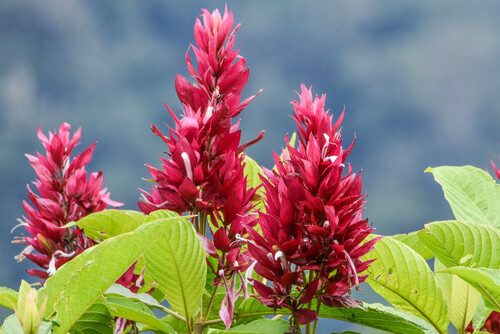
Brazilian red-cloak
Megaskepasma erythrochlamys
A spectacular tropical giant, the Brazilian red-cloak commands attention with its massive crimson flower spikes and lush, pink-veined foliage.
Quick Identification
Size
Height up to 3 meters (10 feet) with a spread of 2 meters (6.5 feet); leaves are 12-30 cm (5-12 inches) long
Colors
Dark green leaves with distinct pink midribs; brilliant crimson-red flower bracts and small white petals
Key Features
- Large erect heads of crimson bracts
- Broad ovate dark green leaves with pink midribs
- Showy two-lipped white flowers
- Free-branching upright shrub habit
When You’ll See Them
Geographic range
Where Does the Brazilian red-cloak Live?
The Brazilian red-cloak is native to the tropical regions of northern South America, specifically originating in the lush landscapes of Venezuela and Suriname. Because of its stunning ornamental value, it has been widely introduced across the Caribbean, Central America, and humid subtropical pockets of the United States like Florida and Hawaii. It thrives in high-humidity environments where temperatures rarely dip toward freezing.
Basemap © OpenStreetMap contributors
Behavior
The Brazilian red-cloak is a vigorous, woody shrub known for its spectacular flowering displays. Unlike many tropical plants that produce brief blooms, this species holds its colorful crimson bracts for several months, making it a reliable focal point in any landscape. It grows with an upright, branching habit, often becoming quite top-heavy when in full bloom due to the weight of the massive flower spikes.
In a garden setting, it acts as a magnet for biodiversity. While the plant itself is stationary, its life cycle is intimately tied to local fauna. It is a prolific nectar producer, specifically evolved to attract long-billed pollinators. In its native and introduced ranges, it is frequently visited by hummingbirds and large butterflies, who find the white tubular flowers hidden within the red bracts to be an irresistible food source.
EverydayEarth exclusive
Camera Tips
Capturing the Brazilian red-cloak on camera is less about the plant's movement and more about the incredible wildlife it attracts. To get the best shots, position your camera at a 45-degree angle to the flower spikes, roughly 1.5 to 2 meters off the ground. This height is the 'sweet spot' where hummingbirds and butterflies typically hover to feed from the white blossoms peeking out of the red bracts.
Because the crimson color is so saturated, it can often 'blow out' or lose detail in direct, harsh midday sun. For the most professional-looking images, set your camera to capture during the 'golden hours' of shortly after sunrise or just before sunset. If your AI camera allows for shutter speed adjustments, use a fast setting (at least 1/1000s) to freeze the motion of visiting pollinators, or use a time-lapse mode to record the gradual opening of the bracts over several weeks.
Stability is key if you are monitoring the plant for growth patterns. Use a sturdy tripod or a permanent fence mount, as the large leaves of the Brazilian red-cloak catch the wind like sails, which can cause significant motion blur in low-light conditions. If you are placing a trail camera near the base to catch ground-dwelling visitors attracted by fallen blooms, ensure the lens is angled upward to capture the contrast between the dark green foliage and the red spikes.
Similar Species
Species that look similar or are commonly confused with Brazilian red-cloak.
Frequently Asked Questions
Record Brazilian red-cloak at your habitat
Connect a camera to start building your own species record — AI identifies every visitor automatically.