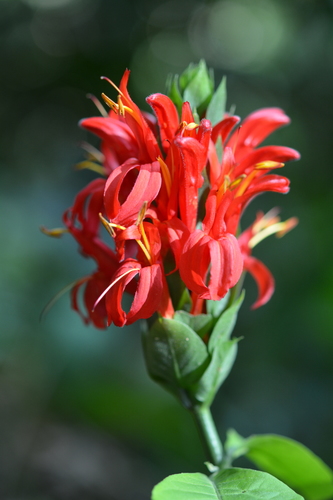
Cardinal's guard
Pachystachys coccinea
A scarlet beacon for hummingbirds, the Cardinal's guard is a stunning tropical shrub that transforms any garden into a pollinator paradise. Its fiery red spikes and lush green foliage make it a must-have for backyard wildlife enthusiasts.
Quick Identification
Size
2 to 6 feet (0.6 to 1.8 meters) tall with a spread of 2 to 4 feet (0.6 to 1.2 meters)
Colors
Glossy dark green foliage with terminal spikes of brilliant scarlet-red tubular flowers
Key Features
- Brilliant red tubular flowers emerging from green bracts
- Large, ovate dark green leaves with prominent veining
- Upright, woody perennial shrub growth habit
When You’ll See Them
Geographic range
Where Does the Cardinal's guard Live?
Cardinal's guard is native to the lush, humid regions of South America, specifically originating in the tropical landscapes of Brazil, French Guiana, and Peru. Over time, it has become a popular ornamental species across Central America and the Caribbean, where the warm, frost-free climate allows it to thrive year-round. In the United States, it is frequently found in the coastal gardens of Florida and Southern California, as well as in greenhouse collections in cooler temperate zones.
Basemap © OpenStreetMap contributors
Behavior
Cardinal's guard is a vigorous, evergreen perennial shrub that serves as a high-traffic hub for nectar-seeking wildlife. While the plant remains stationary, its growth pattern is characterized by upright stems that produce dramatic, torch-like flower spikes at their tips. These flowers are specifically evolved to attract long-tongued pollinators, making the plant a dynamic centerpiece in any tropical or subtropical landscape.
In a backyard setting, this species is relatively low-maintenance but thrives on attention to moisture and light. It does not exhibit "behavior" in the animal sense, but it does respond visibly to its environment; its large leaves will droop significantly if the soil becomes too dry, serving as a natural indicator for the gardener. When in full bloom, it becomes a social focal point for territorial hummingbirds who may compete for access to its nectar.
EverydayEarth exclusive
Camera Tips
To capture the most exciting activity on your Cardinal's guard, place your camera on a tripod or mount it at a height of 3 to 4 feet, roughly level with the top of the flower spikes. The primary goal is to catch hummingbirds and butterflies as they hover near the red tubular blooms. Aim the lens so the flower spikes are slightly off-center to allow room for the wings of visiting birds to fill the frame without being cropped out.
Because hummingbirds move with incredible speed, use a camera setting with a high frame rate or a fast trigger speed. If your AI camera has a "Small Animal" or "Bird" detection mode, ensure it is enabled and set to high sensitivity. To prevent the camera from constantly triggering due to wind-blown leaves, try to position the plant in a sheltered spot or use a camera with adjustable detection zones that focus solely on the flowers themselves.
Lighting is critical for bringing out the vibrant scarlet of the blooms. Position your camera so the sun is behind it (facing away from the sun) during the morning hours. Early morning light between 7:00 AM and 10:00 AM is the golden window, as this is when hummingbirds are most active and the nectar production is at its peak. Avoid backlighting the plant, which can turn the brilliant red flowers into dark silhouettes.
For the best video results, use a short trigger interval of 5-10 seconds. Hummingbirds often visit a single spike multiple times in a short window. If you want to attract more wildlife to the camera's field of view, ensure the Cardinal's guard is well-watered and occasionally fertilize it with a high-phosphorus blend to encourage more flower spikes, which act as a natural, irresistible lure.
Similar Species
Species that look similar or are commonly confused with Cardinal's guard.
Frequently Asked Questions
Record Cardinal's guard at your habitat
Connect a camera to start building your own species record — AI identifies every visitor automatically.