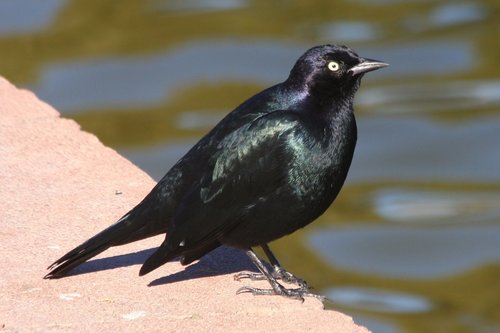
Brewer's Blackbird
Euphagus cyanocephalus
Bold, social, and strikingly iridescent, the Brewer's Blackbird is a master of the modern landscape. Known for their piercing yellow eyes and confident stride, these birds bring a flash of metallic color to backyards across the West.
Quick Identification
Size
Length: 20-26 cm (8-10 in); Wingspan: 37-40 cm (15-16 in); Weight: 50-70 g (1.8-2.5 oz)
Colors
Males are glossy black with an iridescent purple sheen on the head and green on the body; females are a subtle, uniform grayish-brown.
Key Features
- Striking pale yellow to white eyes in males
- Iridescent purple head and greenish body sheen
- Straight, sharply pointed black bill
- Walking gait rather than hopping
When You’ll See Them
Geographic range
Where Does the Brewer's Blackbird Live?
The Brewer's Blackbird is a quintessentially North American species, primarily found across the western and central portions of the continent. Their core range extends from the Canadian provinces of British Columbia and Manitoba down through the western United States and into central Mexico. While they were originally birds of the open plains, they have successfully expanded eastward into the Great Lakes region, following human development and forest clearing. Today, they are permanent residents in much of the West, while populations in the northern prairies migrate south to the United States and Mexico for the winter months.
Basemap © OpenStreetMap contributors
Behavior
Brewer's Blackbirds are highly social and intelligent birds that are often seen in small to large flocks, especially outside of the breeding season. They are remarkably bold around humans, frequently patrolling park benches, outdoor cafes, and parking lots for crumbs. Unlike many other songbirds that hop, Brewer's Blackbirds have a distinctive, rhythmic walk that they use while foraging on the ground.
During the nesting season, they become fiercely territorial and are known to dive-bomb potential predators—including humans—that get too close to their nests. Their communication is a complex mix of metallic 'chek' calls and wheezing, creaking songs that sound a bit like a rusty gate hinge. They often forage in mixed flocks with other blackbirds and starlings, showing a high degree of social flexibility.
EverydayEarth exclusive
Camera Tips
To capture the best footage of Brewer's Blackbirds, your camera should be positioned low to the ground. These birds are terrestrial foragers, spending most of their time walking across lawns or dirt patches. Mounting your AI camera on a short stake about 6 to 12 inches off the ground, angled slightly upward, will provide a dramatic 'bird's eye view' of their iridescent plumage and striking white eyes. Place the camera near a flat, open area rather than in dense brush.
Water is a massive draw for this species. A ground-level bird bath or a shallow stone basin will attract them for both drinking and vigorous bathing. If you are using a feeder to lure them, skip the hanging tubes and opt for a large platform feeder or simply scatter cracked corn and sunflower hearts directly on a clean patch of ground. They are much more comfortable feeding on a flat surface where they can walk freely.
Because the males have highly reflective, iridescent feathers, lighting is critical. Position your camera so the sun is behind it (facing north or south) to avoid silhouettes. The morning sun will highlight the purple and green sheens that otherwise look plain black in deep shade. Set your camera's trigger sensitivity to high, as these birds move quickly and often travel in groups; a multi-shot burst or a 15-second video clip is best for capturing their social interactions and 'head-up' territorial displays.
Similar Species
Species that look similar or are commonly confused with Brewer's Blackbird.
Common Grackle
Larger with a significantly longer, keel-shaped tail and a heavier bill.
Brown-headed Cowbird
Smaller with a shorter, thicker 'finch-like' bill; males have a brown head and dark eyes.
Rusty Blackbird
Very similar pale eye, but prefers wooded swamps and has more rusty-edged feathers in winter.
Frequently Asked Questions
Record Brewer's Blackbird at your habitat
Connect a camera to start building your own species record — AI identifies every visitor automatically.