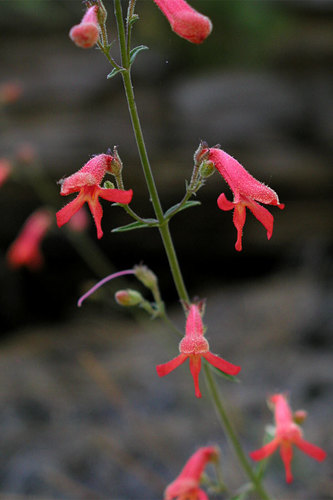
Bridges' penstemon
Penstemon rostriflorus
Boasting brilliant scarlet blooms with a unique 'beaked' shape, Bridges' penstemon is a high-altitude powerhouse that draws hummingbirds from miles around. This hardy perennial is the perfect anchor for any drought-tolerant wildlife garden.
Quick Identification
Size
30 to 100 cm (12 to 40 inches) in height, with a spread of 30 to 60 cm (12 to 24 inches)
Colors
Brilliant scarlet to orange-red tubular flowers with a yellowish interior; foliage is medium green to grey-green.
Key Features
- Distinctive 'beaked' upper lip on the flower tube
- Long, narrow, scarlet-red tubular blossoms
- Woody base with lance-shaped, opposite leaves
- Perennial growth habit forming multi-stemmed clumps
When You’ll See Them
Geographic range
Where Does the Bridges' penstemon Live?
Bridges' penstemon is a quintessential native of the North American Southwest, thriving across the rugged landscapes of the United States and Northern Mexico. Its core territory stretches from the Sierra Nevada and White Mountains of California, eastward across the Great Basin of Nevada and Utah, and into the rocky slopes of Colorado and Arizona. This hardy species also extends its reach southward into the mountainous regions of Baja California, making it a familiar sight for hikers and nature enthusiasts exploring the high-elevation transition zones of the American West.
Basemap © OpenStreetMap contributors
Behavior
Bridges' penstemon, also known as the beaked penstemon, is a resilient perennial sub-shrub that plays a vital role in its ecosystem as a primary nectar source. Unlike many other penstemon species that bloom early and fade by mid-summer, this species is noted for its remarkably long blooming period, often providing vibrant color from June well into September. It exhibits a woody base that allows it to survive the harsh winters of its high-elevation home, sending up fresh flowering stalks each spring.
In the garden or wild, this plant is a specialist in attracting hummingbirds. Its long, downward-tilting tubular flowers are perfectly shaped for the bills of Broad-tailed or Rufous hummingbirds, who act as its main pollinators. While it is highly drought-tolerant and thrives in poor, rocky soils, it is also surprisingly long-lived for a penstemon, often persisting for several years once it finds a well-drained spot. It rarely interacts directly with humans beyond its use in xeriscaping, where it is prized for its low-maintenance beauty and ability to attract wildlife.
EverydayEarth exclusive
Camera Tips
To capture the best action around Bridges' penstemon, you should treat the plant as a natural stage for hummingbird photography. Position your camera on a tripod approximately 3 to 5 feet away from a healthy cluster of blooming stalks. Because the flowers are tubular and face slightly downward, setting your camera at a slightly lower angle, looking up into the blooms, can yield dramatic shots of visiting pollinators. If your camera allows, use a high shutter speed (1/1000s or faster) to freeze the rapid wingbeats of hummingbirds, or use a burst mode triggered by motion.
Lighting is crucial for this species; the scarlet red petals can easily 'blow out' and lose detail in harsh, direct midday sun. The best results usually occur during the 'golden hours' of early morning or late afternoon when the light is softer and warmer, which enhances the orange-red hues of the blossoms. Angle your camera so the sun is behind you or to the side, rather than pointing directly into the lens, to avoid lens flare and maintain the rich saturation of the flowers.
Since this plant thrives in rocky, well-drained areas, you can enhance your backyard camera setup by placing a few attractive natural stones or a small, shallow water basin near the plant. This creates a more naturalistic 'trail cam' aesthetic and may encourage birds to linger longer in the frame. Avoid using artificial bird feeders too close to the plant if you want to capture 'wild' foraging behavior, as the birds will naturally prioritize the nutrient-rich nectar of the Penstemon rostriflorus over sugar water once they find it.
Similar Species
Species that look similar or are commonly confused with Bridges' penstemon.
Frequently Asked Questions
Record Bridges' penstemon at your habitat
Connect a camera to start building your own species record — AI identifies every visitor automatically.