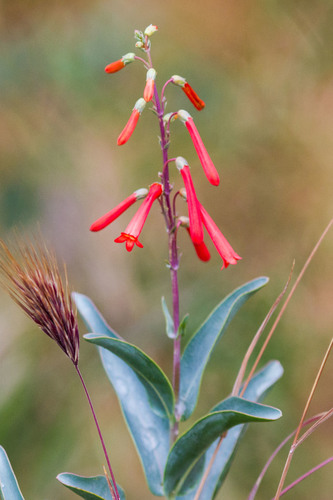
scarlet bugler
Penstemon centranthifolius
A vibrant burst of fire in the dry chaparral, the scarlet bugler is a stunning native wildflower that acts as a natural neon sign for hungry hummingbirds. Its tall, elegant spikes of trumpet-shaped blooms make it the ultimate focal point for backyard wildlife photography.
Quick Identification
Size
Height: 30-120 cm (1-4 feet); Flowers: 2.5 cm (1 inch) long
Colors
Bright scarlet to deep red tubular flowers; stems and leaves are a distinctive waxy, gray-green (glaucous)
Key Features
- Tall, upright flower spikes
- Narrow, tubular scarlet flowers without spreading petals
- Waxy, blue-gray foliage that feels smooth to the touch
- Opposite leaves that often clasp the stem at the base
When You’ll See Them
Behavior
The scarlet bugler is a perennial herb that acts as a vital nectar source in dry, sun-drenched environments. While it remains a modest mound of gray-green foliage for much of the year, it sends up dramatic, towering flower stalks in the spring. It is specifically evolved for hummingbird pollination; the long, narrow tubes of the flowers hold nectar deep inside, accessible only to birds with long bills or insects with long proboscises.
In a backyard setting, this plant is relatively 'social' in terms of ecology, often surrounded by a flurry of activity from Anna’s and Costa’s hummingbirds. It is highly drought-tolerant, having adapted to survive long periods without water by utilizing its waxy leaf coating to prevent moisture loss. For humans, it serves as a low-maintenance 'anchor' plant that brings reliable color and wildlife activity to native gardens.
EverydayEarth exclusive
Camera Tips
To capture the best action around a scarlet bugler, treat the plant as a 'stakeout' location. Since the flowers grow on tall, vertical spikes, place your camera on a tripod or mount it at a height of 3 to 4 feet. Angle the lens slightly downward to capture the full length of the bloom. This is the ideal setup for catching hummingbirds mid-hover as they move from one tubular flower to the next.
Because hummingbirds move incredibly fast, use a camera with a high-speed trigger or a 'burst' mode. If your AI camera has a 'Small Animal' or 'Bird' detection setting, ensure it is active. Position the camera so the sun is behind you or to the side; the bright red petals of the bugler can easily 'wash out' or look overexposed in direct midday sun. Early morning light (the golden hour) makes the scarlet hues glow brilliantly and provides enough natural light for a fast shutter speed.
Avoid using heavy baits or liquid feeders directly next to the plant, as you want to capture the natural foraging behavior on the flowers themselves. However, a shallow water mister nearby can encourage birds to stay in the area longer. Check your camera’s focal distance—since these plants are narrow, you can get quite close (within 2-3 feet) if your camera supports macro or near-field focusing, providing stunning detail of the iridescent feathers of visiting birds against the red petals.
Seasonality is key: start your monitoring in late February if you are in warmer coastal areas, or April for inland locations. Once the flowers turn to seed pods, the camera will be less active for birds, but you might catch small mammals or ground-nesting bees investigating the stalks. Ensure your camera is secured firmly, as the tall stalks of the bugler can sway in the wind and may trigger false motion alerts if they occupy too much of the frame.
Similar Species
Species that look similar or are commonly confused with scarlet bugler.
Firecracker Penstemon
Has deeper green foliage and flowers with tiny petals that fold back at the tip, whereas scarlet bugler has waxy gray leaves and straight tubes.
Cleveland Sage
While also a hummingbird favorite, it has purple, tiered pom-pom flowers and highly fragrant, textured green leaves.
Bridges' Penstemon
Features two-lipped red flowers that appear later in the summer, usually in higher elevation mountain habitats.
Frequently Asked Questions
Record scarlet bugler at your habitat
Connect a camera to start building your own species record — AI identifies every visitor automatically.