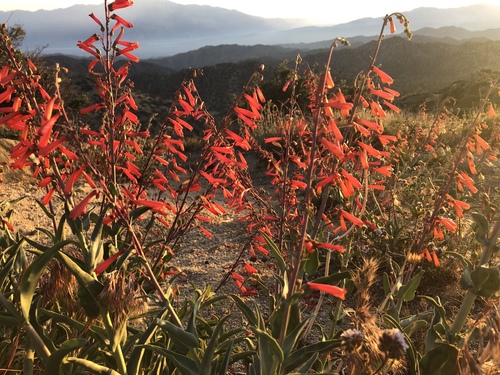
firecracker penstemon
Penstemon eatonii
A burst of scarlet in the desert sun, the firecracker penstemon is nature's favorite hummingbird magnet. Its brilliant red tubes and hardy nature make it the crown jewel of the Western wild garden.
Quick Identification
Size
Height: 12–36 inches (30–90 cm); Flower length: 1–1.5 inches (2.5–4 cm); Spread: 12–18 inches (30–45 cm)
Colors
Brilliant scarlet-red tubular flowers; foliage ranges from deep green to a waxy, glaucous grey-green.
Key Features
- Narrow, tubular scarlet-red flowers
- Multiple upright flowering stalks from a single base
- Leathery, lance-shaped leaves
- Smooth, hairless stems and foliage
When You’ll See Them
Behavior
The firecracker penstemon is a resilient perennial that brings a burst of intense color to the arid landscapes of the Western United States. It is a 'pioneer' species of sorts, often found clinging to rocky slopes, desert washes, and pinyon-juniper woodlands where other plants might struggle. It grows from a woody base (caudex), sending up several unbranched stems that reach toward the sun, each laden with nodding, trumpet-shaped blooms.
This plant is most famous for its specialized relationship with hummingbirds. Because the flowers are narrow and lack a landing platform, they are perfectly adapted for hovering birds with long bills. While it doesn't 'move' in the traditional sense, the firecracker penstemon dictates the movement of wildlife in your yard, acting as a high-octane refueling station for migratory hummingbirds during the spring and early summer months.
EverydayEarth exclusive
Camera Tips
When targeting firecracker penstemon with a backyard camera, your primary goal is actually to capture the fast-moving pollinators it attracts. Position your camera on a tripod or mount about 2 to 3 feet away from a healthy cluster of blooming stalks. Because hummingbirds move with incredible speed, use a 'High Speed' or 'Pro Capture' mode if your camera supports it. A fast shutter speed (at least 1/1000th of a second) is essential to freeze the wing motion, while a mid-range aperture will keep both the flower and the bird in sharp focus.
The best angle is slightly below the flower level, looking up. This perspective captures the hummingbird's iridescent throat (gorget) as it hovers to feed from the downward-facing tubes. To avoid 'ghosting' or blurry images, ensure your camera is positioned to take advantage of the morning sun. Direct, front-lit sunlight between 8:00 AM and 10:00 AM will make the scarlet petals pop and provide enough light for the high shutter speeds required for avian subjects.
If you are interested in the plant's growth itself, firecracker penstemon is an excellent subject for time-lapse photography. Set your camera to take one photo every 2-4 hours over a period of two weeks in the spring. You will be able to see the flowering spikes 'bolt' upward and the tubular flowers unzip from the bottom of the stalk to the top. Just ensure your camera is in a waterproof housing, as spring mountain storms can be unpredictable.
Avoid using traditional motion-trigger settings intended for large mammals, as the small size and rapid movement of hummingbirds often fail to trigger standard PIR sensors. Instead, use a 'Time Lapse' mode with a short interval (e.g., every 15-30 seconds) during peak morning hours, or use a camera with 'AI Subject Detection' specifically tuned for birds to ensure you don't miss the action.
Similar Species
Species that look similar or are commonly confused with firecracker penstemon.
Scarlet Bugler
Has leaves that completely encircle the stem (perfoliate), making the stem look like it is piercing through the center of the leaf.
Bridges' Penstemon
The lower petals of Bridges' Penstemon are strongly reflexed (curled backward), whereas firecracker penstemon petals stay mostly forward-facing.
Frequently Asked Questions
Record firecracker penstemon at your habitat
Connect a camera to start building your own species record — AI identifies every visitor automatically.