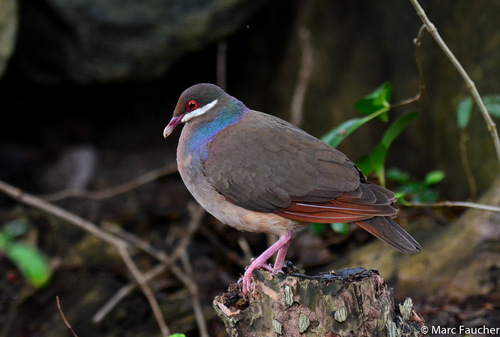
Bridled Quail-Dove
Geotrygon mystacea
A secretive ghost of the Caribbean forest floor, the Bridled Quail-Dove is a master of camouflage. With its striking facial 'bridle' and iridescent plumage, it remains one of the most sought-after sightings for backyard island observers.
Quick Identification
Size
28–30 cm (11–12 in) in length; weighs approximately 230–290 g (8–10 oz)
Colors
Rich reddish-brown upperparts with a metallic green or violet mantle; creamy underparts and a distinctive white 'bridle' stripe below the eye.
Key Features
- Bold white facial stripe starting at the bill and extending below the eye
- Iridescent green and pinkish-purple patch on the sides of the neck
- Stocky, rounded body with a short tail
- Dark reddish-brown wings that contrast with paler underparts
When You’ll See Them
Geographic range
Where Does the Bridled Quail-Dove Live?
Native to the Caribbean islands, the Bridled Quail-Dove is a regional specialist found throughout the northern Lesser Antilles and parts of the Greater Antilles. Its core range extends from the island of Puerto Rico and the Virgin Islands southward through the chain to Saint Lucia. While it is a permanent resident across these islands, its presence is highly dependent on the availability of undisturbed forest floor and dense canopy cover.
Basemap © OpenStreetMap contributors
Behavior
The Bridled Quail-Dove is a notoriously shy and secretive bird, spending the vast majority of its time on the forest floor. Unlike many other doves that congregate in large flocks, this species is typically solitary or found in quiet pairs. They move with a deliberate, slow walk through the leaf litter, occasionally pausing to bob their heads or toss leaves aside in search of food. When startled, they prefer to run into thick undergrowth rather than fly, but if pressed, they will take off with a loud, characteristic whirring of wings.
In terms of social interaction, they are non-aggressive and generally avoid human-populated areas unless there is significant cover and minimal disturbance. Their vocalization is a low, mournful 'whooo' that is easily missed by the untrained ear. Because they are so elusive, they are often detected by their movement in the dry leaves long before they are actually seen.
EverydayEarth exclusive
Camera Tips
To capture the Bridled Quail-Dove on camera, ground-level placement is non-negotiable. These birds rarely venture into the canopy, so mount your AI camera no higher than 12 to 18 inches off the ground. Aim the lens at a natural clearing in the leaf litter or along a known game trail within dense thickets. Because they are easily spooked by sudden movements, ensure the camera is well-camouflaged and positioned in a spot where the sun won't cause high-contrast shadows that might trigger false alerts or wash out their beautiful iridescent neck feathers.
One of the most effective ways to lure a Bridled Quail-Dove into frame is the use of a small, dripping water feature. In dry forest habitats, the sound of water is a powerful magnet for this species. A simple birdbath placed at ground level or a slow-dripping hose near a shaded patch of dirt will often bring them out of hiding. Avoid using bright white-light flashes at night, as this may scare them away from the area for days; instead, rely on high-quality infrared sensors that can trigger silently as they forage during the dim light of dawn and dusk.
Set your camera to take short video clips (10-15 seconds) rather than just still photos. Their behavior—the rhythmic head-bobbing and the cautious way they toss leaves—is fascinating to watch and provides a better chance of seeing the distinctive white facial stripe, which can be obscured if the bird is looking away in a single frame. Early morning, just as the sun begins to penetrate the understory, is the peak time for activity, so ensure your camera's sensitivity is optimized for low-light conditions.
Similar Species
Species that look similar or are commonly confused with Bridled Quail-Dove.
Frequently Asked Questions
Record Bridled Quail-Dove at your habitat
Connect a camera to start building your own species record — AI identifies every visitor automatically.