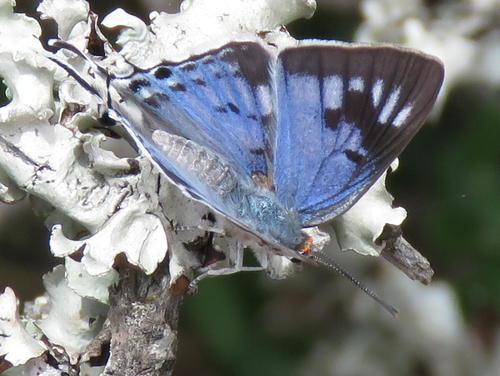
Bright Marbled Sapphire
Stugeta bowkeri
A shimmering jewel of the African savanna, the Bright Marbled Sapphire dazzles with its metallic blue wings and intricate, camouflage-style underside. This agile flyer is a prized sight for backyard naturalists across Southern Africa.
Quick Identification
Size
Wingspan of 26–32 mm (1.0–1.25 in) for males and 29–35 mm (1.1–1.4 in) for females
Colors
Upperside is brilliant pale blue with black borders; underside features a complex marbled pattern of white, ochre, and brown with orange-rimmed black eyespots
Key Features
- Brilliant sky-blue upperside with thick black wing margins
- Intricate 'marbled' underside pattern of white, tan, and orange
- Long, delicate hair-like tails on the hindwings
- Small orange and black eyespots near the tail base
- Fast, erratic flight pattern
When You’ll See Them
Geographic range
Where Does the Bright Marbled Sapphire Live?
The Bright Marbled Sapphire is native to the African continent, with a primary range spanning across Southern and Eastern Africa. It is commonly found from South Africa and Namibia up through Botswana, Zimbabwe, and Mozambique, reaching into the northern tropical savannas of Kenya and Tanzania. This species is a resident throughout its range, thriving wherever its specific host plants are found in both wild and urban settings.
Basemap © OpenStreetMap contributors
Behavior
The Bright Marbled Sapphire is a highly active and territorial butterfly species. Males are famous for a behavior known as 'hilltopping,' where they congregate at the highest points of their local environment to compete for territory and wait for passing females. They are incredibly fast fliers, often appearing as a blue blur as they zip between perches to chase away rivals or investigate potential mates.
These butterflies have a fascinating ecological relationship with ants. Their larvae are often attended by cocktail ants (Crematogaster species), which protect the caterpillars from predators. In return, the caterpillars provide the ants with a sugary substance secreted from specialized glands. This mutualistic bond ensures a higher survival rate for the butterfly during its vulnerable early stages. Adults are frequently found basking in the sun with wings partially open to regulate their body temperature.
EverydayEarth exclusive
Camera Tips
To capture high-quality images of the Bright Marbled Sapphire, placement is everything. These butterflies are drawn to Sourplum trees (*Ximenia caffra* or *X. americana*), which serve as their larval host. Position your camera about 2 to 3 feet away from these bushes or near nectar-rich flowers like *Plumbago* or *Buddleja*. Since they are small and fast, a camera with a high-speed trigger and a macro focal length is ideal for capturing the fine details of their marbled wings.
Focus your camera on sunlit 'perching posts'—the outermost twigs of a bush that receive direct sunlight. Males will return to these exact spots repeatedly after chasing off intruders. For the best color saturation, ensure your camera is positioned so the sun is behind you, illuminating the butterfly's metallic blue upperside. Mid-morning to early afternoon provides the peak light levels needed for fast shutter speeds, which are necessary to freeze their rapid wing movements.
If you are struggling to get them to land in a specific frame, consider a 'butterfly puddle.' Create a small patch of damp sand mixed with a tiny amount of sea salt or compost. Butterflies like the Bright Marbled Sapphire often land on damp ground to 'puddle,' absorbing essential minerals. This provides a rare moment of stillness, allowing your AI camera to capture the intricate underside patterns that give this species its name.
Similar Species
Species that look similar or are commonly confused with Bright Marbled Sapphire.
Frequently Asked Questions
Record Bright Marbled Sapphire at your habitat
Connect a camera to start building your own species record — AI identifies every visitor automatically.