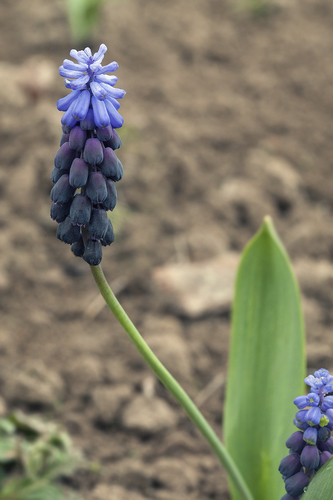
Broad-leaved Grape-hyacinth
Muscari latifolium
A Turkish mountain treasure, the Broad-leaved Grape-hyacinth stuns with its dramatic two-tone indigo spikes and lush, wide foliage. It is an essential early-spring beacon for pollinators and a sophisticated addition to any wildlife-friendly garden.
Quick Identification
Size
Stems reach 15–30 cm (6–12 inches) tall; leaves are 2-3 cm (0.8–1.2 inches) wide
Colors
Distinct bi-colored flower spikes with bright violet-blue sterile florets at the top and deep indigo or near-black fertile florets at the base
Key Features
- Single or pair of broad, lance-shaped leaves resembling tulip leaves
- Bi-colored flower spike with light blue top and dark indigo bottom
- Dense, bell-shaped florets on a sturdy, upright stem
- Clump-forming growth habit that does not spread aggressively
When You’ll See Them
Geographic range
Where Does the Broad-leaved Grape-hyacinth Live?
The Broad-leaved Grape-hyacinth is native to the mountainous regions of western and southern Turkey, where it is found growing among pine needles and in high-altitude scrublands. While its natural endemic range is focused on the Anatolian peninsula, it has been widely introduced across Europe and North America as a popular ornamental garden plant. In these non-native regions, it thrives in temperate climates and is commonly found in residential landscapes, though it rarely naturalizes in the wild as aggressively as other grape hyacinth species.
Basemap © OpenStreetMap contributors
Behavior
The Broad-leaved Grape-hyacinth is a spring ephemeral, a perennial bulb that completes its reproductive cycle early in the year to take advantage of the sunlight reaching the ground before the forest canopy fully develops. It emerges from dormancy in late winter, sending up its unique broad foliage followed quickly by its striking bi-colored floral spikes. Unlike many of its relatives in the Muscari genus, this species is well-behaved and tends to grow in neat, predictable clumps rather than spreading uncontrollably through the garden.
This plant plays a vital role in early spring ecosystems by providing a high-contrast visual target for emerging pollinators. The sterile, bright blue flowers at the very top of the spike act as a 'flag' to attract bees from a distance, while the darker fertile flowers below contain the nectar and pollen. By late spring, the plant begins to wither, retreating back into its bulb to store energy for the following year, leaving behind seed pods that eventually dry and split.
EverydayEarth exclusive
Camera Tips
Capturing the Broad-leaved Grape-hyacinth with an AI camera offers a unique opportunity to document the micro-world of spring pollinators. Because the plant is low-growing and stationary, you should place your camera on a mini-tripod or directly on a flat stone at ground level. Angle the lens slightly upward to emphasize the 'tower' effect of the flower spikes. For the best focus, ensure your camera is positioned about 12 to 18 inches away from the blooms; if your device has a macro lens or setting, this is the perfect time to use it.
To capture high-quality wildlife interactions, set your camera to 'Video' or 'High-Speed Burst' mode. This species is a favorite for queen bumblebees and hoverflies. These insects are most active during the warmest hours of the day, typically between 10 AM and 2 PM. Because the bottom of the flower is very dark (almost black), cameras can sometimes struggle with exposure. Try to position your camera so the sun is behind you, illuminating the face of the flower, or wait for a slightly overcast day to capture the subtle textures of the indigo bells without harsh shadows.
If your camera supports time-lapse, the Broad-leaved Grape-hyacinth is an ideal subject. Set your camera to take a photo every 30 minutes over a period of two weeks in early spring. This will allow you to see the 'unzipping' effect as the flower spike elongates and the buds transition from a dull green to their signature bi-colored brilliance. To protect your equipment from spring rain and mud splashes, use a small clear housing or a DIY rain shield, as the low placement makes the lens vulnerable to dirt during heavy downpours.
Similar Species
Species that look similar or are commonly confused with Broad-leaved Grape-hyacinth.
Frequently Asked Questions
Record Broad-leaved Grape-hyacinth at your habitat
Connect a camera to start building your own species record — AI identifies every visitor automatically.