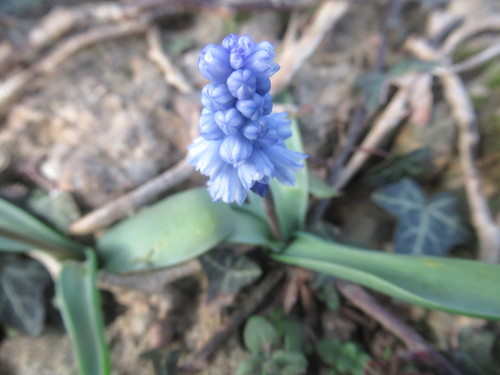
Azure Grape-hyacinth
Muscari azureum
A vibrant herald of spring, the Azure Grape-hyacinth paints backyard gardens in rare shades of sky-blue. Unlike other grape hyacinths, its open, bell-shaped blooms offer an inviting landing pad for the season's first pollinators.
Quick Identification
Size
Height of 10–20 cm (4–8 inches); flower spikes 2–5 cm (1–2 inches) long
Colors
Bright azure or sky blue flowers; grayish-green or glaucous foliage
Key Features
- Dense, conical clusters of bell-shaped flowers
- Outer petals remain open at the mouth, unlike most grape hyacinths
- Faint white pinstripes on each bell
- 2-3 strap-like, channelled leaves per bulb
When You’ll See Them
Geographic range
Where Does the Azure Grape-hyacinth Live?
The Azure Grape-hyacinth is originally native to the mountains of Turkey, where it thrives in rocky, high-altitude alpine meadows. Beyond its native Western Asia, it has become a staple of temperate gardens across Europe and North America. While it is rarely invasive, it often naturalizes in suburban lawns and parklands in USDA zones 4 through 8, appearing reliably each spring as a herald of warmer weather.
Basemap © OpenStreetMap contributors
Behavior
Azure Grape-hyacinth is a hardy spring ephemeral that follows a distinct seasonal rhythm. It emerges from a bulb in late winter or very early spring, sending up narrow, silver-toned leaves followed quickly by its signature sky-blue flower spikes. Unlike many of its cousins in the Muscari genus, the flowers of this species are more 'open' and bell-shaped, rather than constricted at the neck, giving the clusters a softer, fluffier appearance.
As a perennial, it spends the majority of the year in a dormant state beneath the soil. After blooming for 3–4 weeks in March or April, the plant focuses on seed production and recharging its bulb before the foliage withers away completely by early summer. It is a social plant, often forming dense carpets over time through both seed dispersal and the production of small 'offsets' or daughter bulbs.
EverydayEarth exclusive
Camera Tips
To capture the stunning detail of Azure Grape-hyacinth, you need to get low. Since these plants rarely exceed 8 inches in height, place your camera on a small tripod or directly on a flat stone at ground level. Angle the lens slightly upward to emphasize the conical structure of the flower spikes against the sky or background greenery. Because they bloom in early spring when the sun is lower, the 'golden hour' light in the late afternoon can make the azure blue petals appear to glow from within.
While the plant itself is stationary, it is a magnet for early-season pollinators. Set your camera to a fast shutter speed or use a high-frame-rate video setting to catch queen bumblebees and hoverflies as they visit the bells. If your AI camera has a macro mode, this is the time to use it; the fine white lines on the petals and the pollen-dusted interior of the bells are best captured at a distance of 4–10 inches.
For a unique perspective, try a time-lapse over a period of 48 hours. This allows you to see the individual florets opening from the bottom of the spike upward. Since spring weather is unpredictable, ensure your camera housing is waterproof, as the sight of Azure Grape-hyacinth dusted with a light morning frost or sparkling with raindrops provides some of the most professional-looking wildlife photography opportunities available in a backyard setting.
Similar Species
Species that look similar or are commonly confused with Azure Grape-hyacinth.
Frequently Asked Questions
Record Azure Grape-hyacinth at your habitat
Connect a camera to start building your own species record — AI identifies every visitor automatically.