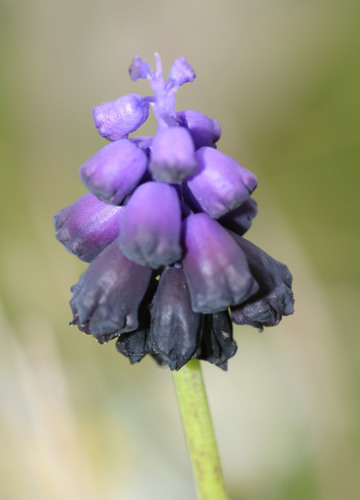
Dark Grape-hyacinth
Muscari commutatum
A masterpiece of the Mediterranean spring, the Dark Grape-hyacinth is famous for its near-black, velvety blooms. This resilient wildflower adds a touch of dramatic, gothic beauty to rocky gardens and sun-drenched landscapes.
Quick Identification
Size
Height 10-25 cm (4-10 inches); Flower spikes 2-5 cm (0.8-2 inches) long
Colors
Deep midnight blue to blackish-purple flowers; dull grayish-green linear leaves
Key Features
- Densely packed flower spikes of dark, ink-blue bells
- Flower mouth is the same dark color as the body, lacking white lobes
- All flowers on the spike are fertile and uniform in color
- Narrow, channeled leaves that typically trail along the ground
When You’ll See Them
Geographic range
Where Does the Dark Grape-hyacinth Live?
Native to the sun-soaked regions of Southeastern Europe and the Eastern Mediterranean, the Dark Grape-hyacinth is most commonly found in Greece, Italy, and the Balkan Peninsula. Its range extends eastward into Turkey and across many of the Aegean Islands, where it thrives in rocky, well-drained terrain. While it is a specialist of Mediterranean climates, it has been introduced to various temperate regions across Europe as a curated garden plant, though it rarely escapes into the wild in cooler northern latitudes.
Basemap © OpenStreetMap contributors
Behavior
The Dark Grape-hyacinth is a hardy spring ephemeral that spends the majority of its life cycle as a dormant bulb beneath the soil. It emerges in late winter or early spring, sending up narrow, grass-like foliage followed by a stout flowering stalk. Unlike many common garden bulbs, this species is known for its exceptionally dark, moody coloration, which serves to absorb solar heat in the cool Mediterranean spring, aiding in its metabolic processes.
As a self-supporting herb, it relies on its stored bulb energy to produce a rapid burst of growth. While it doesn't 'behave' in the animal sense, it shows a clear affinity for rocky, well-drained soils where it can avoid competition from taller grasses. It is a vital early-season nectar source for bees emerging from hibernation, and it spreads slowly over years to form small, concentrated colonies that can turn a patch of garden soil into a sea of deep violet.
EverydayEarth exclusive
Camera Tips
To capture the Dark Grape-hyacinth effectively, you need to think like a macro photographer. Because these plants are low to the ground, place your AI-powered camera on a ground-level mount or use a 'bean bag' stabilizer to get the lens within 6-12 inches of the flower spike. Angle the camera slightly upward to give the small flowers a more 'heroic' appearance against the sky or background foliage. Avoid placing the camera directly above the plant, as top-down shots often lose the detail of the individual bell-shaped florets.
Lighting is your biggest challenge with this species. The flowers are so dark they can easily appear as a featureless black blob in bright sunlight. Position your camera so the sun is at a 45-degree angle to the plant (side-lighting); this creates shadows that define the shape of each tiny bell. If your camera allows for manual exposure, try underexposing slightly to preserve the rich, velvety texture of the deep purple petals without blowing out the highlights on the green leaves.
Since the plant is stationary, use your camera’s time-lapse mode to record the blooming process. Setting an interval of one photo every hour over a week in April will capture the dramatic 'unzipping' of the flower spike as the lower bells mature and open. Additionally, the Dark Grape-hyacinth is a magnet for early-season pollinators. Set your motion trigger sensitivity to high and focus on the flower head to catch shots of foraging mason bees and hoverflies that frequent these blooms during the warmest part of the day.
Similar Species
Species that look similar or are commonly confused with Dark Grape-hyacinth.
Frequently Asked Questions
Record Dark Grape-hyacinth at your habitat
Connect a camera to start building your own species record — AI identifies every visitor automatically.