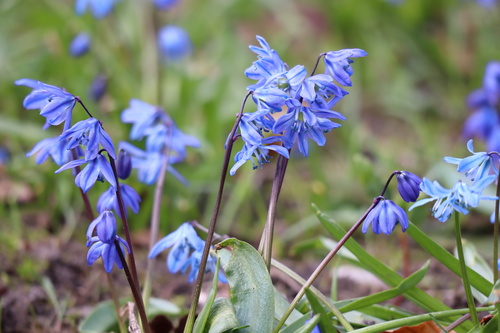
Siberian squill
Scilla siberica
The first true blue of spring, Siberian squill transforms garden floors into a shimmering azure carpet before the trees even wake up.
Quick Identification
Size
4-8 inches (10-20 cm) in height; leaves 4-6 inches (10-15 cm) long
Colors
Electric Prussian blue flowers; vibrant green foliage; unique blue-tinted pollen
Key Features
- Nodding, bell-shaped flowers with six petals
- Deep blue mid-vein on each petal
- Strap-shaped, succulent green leaves
- Low-growing, carpet-forming growth habit
When You’ll See Them
Behavior
Siberian squill is a spring ephemeral, a group of plants that squeeze their entire reproductive life cycle into the brief window between the spring thaw and the leafing out of deciduous trees. They emerge from small underground bulbs as soon as the soil temperatures rise above freezing, often blooming while patches of snow still remain on the ground. Because they disappear into dormancy by early summer, they are often referred to as 'sleepers' in the garden landscape.
While they don't move like animals, they are highly active in their interaction with the environment. They utilize a strategy called 'naturalizing,' where they spread both by bulb offsets and by seed. Interestingly, their seeds have a fleshy attachment called an elaiosome, which attracts ants. The ants carry the seeds back to their nests, effectively acting as the plant's transportation system to colonize new areas of your yard.
EverydayEarth exclusive
Camera Tips
Capturing Siberian squill requires a different approach than fast-moving wildlife. Because these plants are only a few inches tall, you must get your camera down to ground level. If you are using a trail camera, mount it on a 'tent stake' mount or a low-profile brick rather than a tree trunk. Aim for a slightly upward angle to capture the 'nodding' interior of the bell-shaped flowers, which is where the most interesting detail—the blue pollen—resides.
The most rewarding way to use a backyard camera with Siberian squill is to utilize the 'Time-Lapse' function. Set your camera to take a photo every 15 to 30 minutes over a period of 48 hours during a sunny week in late March. When played back, you will see the dramatic 'pulse' of the plant as the flowers open wide in the morning sun and close tightly at night to protect their nectar. This reveals the plant’s circadian rhythm in a way the naked eye rarely notices.
Pay close attention to your camera's White Balance settings. The 'Prussian blue' of Scilla siberica is so intense that many digital sensors struggle to render it accurately, often turning it purple or 'blowing out' the color detail. If your camera allows for manual adjustment, set it to 'Daylight' to keep the blues true to life. For a 'wildlife' angle, focus your camera on a dense patch of flowers on a warm spring day to capture early-season pollinators like hoverflies and honeybees, which are highly attracted to the blue blossoms.
Similar Species
Species that look similar or are commonly confused with Siberian squill.
Frequently Asked Questions
Record Siberian squill at your habitat
Connect a camera to start building your own species record — AI identifies every visitor automatically.