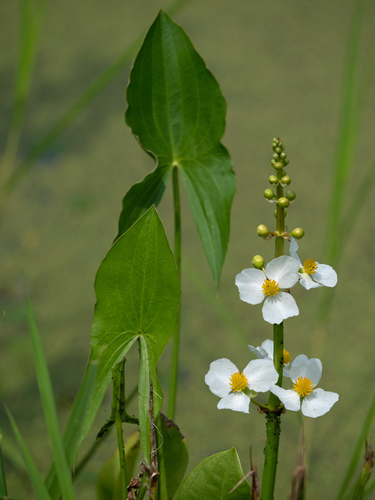
broadleaf arrowhead
Sagittaria latifolia
The broadleaf arrowhead is a striking wetland icon known for its spear-shaped foliage and edible 'duck potato' tubers. A favorite of pollinators and waterfowl alike, it is the architect of the marshy shoreline.
Quick Identification
Size
Height 30-120 cm (1-4 ft); leaves 10-30 cm (4-12 in) long.
Colors
Bright emerald green foliage; brilliant white flowers with yellow (male) or green (female) centers.
Key Features
- Distinctive arrowhead or spear-shaped leaves with pointed basal lobes
- Flowers arranged in whorls of three on an upright stalk
- Spongy, succulent stems growing from submerged mud
- Produces round, starchy underground tubers (duck potatoes)
When You’ll See Them
Geographic range
Where Does the broadleaf arrowhead Live?
Native to the North American continent, the broadleaf arrowhead is found extensively from the southern reaches of Canada down through the United States and Mexico, stretching into northern South America. It is most abundant in temperate and subtropical regions of the US, particularly along the Atlantic and Gulf coastal plains and throughout the Mississippi River basin. While indigenous to the Americas, it has been introduced to parts of Europe and Oceania where it occasionally naturalizes in suitable wetland habitats.
Basemap © OpenStreetMap contributors
Behavior
Broadleaf arrowhead is a hardy aquatic perennial that serves as a cornerstone of wetland ecosystems. It is a pioneer species, often among the first to colonize new ponds, marshy edges, or disturbed wetlands. The plant exhibits high morphological plasticity, meaning its leaf shape can change dramatically based on water depth and flow; submerged leaves may appear narrow and ribbon-like, while emergent leaves take on the classic broad spearhead shape to maximize sunlight absorption.
Throughout the growing season, the plant spreads horizontally through an aggressive network of rhizomes, eventually forming dense colonies that stabilize shorelines and provide vital cover for aquatic life. During the late summer months, it sends up flowering stalks that attract a wide array of pollinators. As autumn approaches, the plant funnels its energy downward into the substrate, forming starchy, marble-sized tubers that allow it to survive winter dormancy even when the water surface freezes.
EverydayEarth exclusive
Camera Tips
To capture the life of a broadleaf arrowhead colony, position your camera on a waterproof stake or tripod roughly 12 to 24 inches above the water line. Because the plant itself is stationary, focus your lens on a cluster of flower buds in mid-summer. This setup acts as a natural stage for capturing insect pollinators like hoverflies, solitary bees, and dragonflies, which frequently use the broad leaves as hunting platforms or resting spots.
Wetland environments are notoriously tricky for light exposure due to water reflections. Angle your camera to avoid direct glare from the sun, or position it so the morning light illuminates the translucent petals of the white flowers from the side. Using a camera with a high-trigger speed is essential if you hope to catch the rapid movement of dragonflies or the occasional hummingbird that may visit the blooms. If your camera supports time-lapse mode, set it to take one photo every hour during the spring to document the 'emergence' phase as the first leaves pierce the water's surface.
Don't stop recording when the flowers fade! In the autumn, reposition your camera to face the base of the plants where they meet the water. This is the prime time to capture waterfowl, such as Mallards or Wood Ducks, as they forage in the mud. These birds are highly attracted to the nutritious 'duck potato' tubers, and you can often get excellent footage of 'tipping' behavior as they reach for the roots just beneath the surface.
Similar Species
Species that look similar or are commonly confused with broadleaf arrowhead.
Frequently Asked Questions
Record broadleaf arrowhead at your habitat
Connect a camera to start building your own species record — AI identifies every visitor automatically.