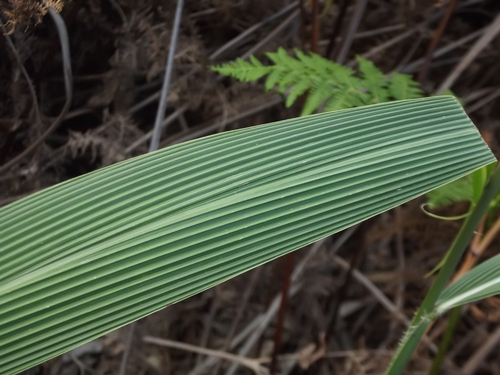
Broadleaf Bristlegrass
Setaria megaphylla
A towering, ribbon-like grass that serves as a bustling hub for backyard birds and beneficial insects. Its unique pleated leaves and heavy seed spikes make it both a beautiful ornamental and a vital wildlife sanctuary.
Quick Identification
Size
Height: 1-2.5 meters (3.3-8.2 feet); Leaf width: up to 10 cm (4 inches)
Colors
Bright emerald green foliage; seed heads range from light green to a deep, purplish-brown
Key Features
- Deeply pleated, accordion-like leaf blades
- Broad leaves resembling young palm fronds
- Bristly, spike-like seed heads up to 50cm long
- Dense, fountain-like clumping habit
When You’ll See Them
Geographic range
Where Does the Broadleaf Bristlegrass Live?
Native to the lush subtropical and tropical regions of South-eastern Africa, Broadleaf Bristlegrass is widely distributed from Ethiopia and Kenya down through Mozambique to South Africa. Because of its value as a hardy forage crop and its attractive ribbon-like foliage, it has been exported globally. It has now successfully naturalized in several other warm climates, including the southeastern United States—most notably Florida—as well as parts of Australia, Southeast Asia, and South America, where it often thrives in the humid 'edge' habitats between forests and urban development.
Basemap © OpenStreetMap contributors
Behavior
Broadleaf Bristlegrass is a vigorous, perennial grass known for its architectural beauty and its role as a cornerstone of backyard ecosystems. Unlike many turf grasses, it grows in large, structural clumps that provide significant vertical interest and dense cover. It is particularly known for its rapid growth during the rainy season, when it sends up tall, arching stems topped with fuzzy, seed-heavy panicles that sway in the slightest breeze.
While the plant itself is stationary, it exhibits a dynamic relationship with the environment. It acts as a 'nursery' for various insect species and provides a critical high-energy food source for granivorous birds. In gardens, it is often used for erosion control or as a natural screen, though its prolific seeding nature means it can quickly expand its footprint if not managed. It is highly resilient, capable of bouncing back from grazing or mowing once its root system is established.
EverydayEarth exclusive
Camera Tips
To capture the best action on your backyard camera, treat Broadleaf Bristlegrass as a stage rather than just a background. The heavy, seed-laden spikes are a primary attractant for finches, waxbills, and other small birds. Mount your camera on a garden stake or low tripod at a height of about 3 to 4 feet, aimed directly at a cluster of ripening seed heads. Because these stalks sway in the wind, use a fast trigger speed and high frame rate to ensure the birds landing on them remain in sharp focus.
For the most dramatic shots, position your camera so the sun is behind the grass (backlighting). This makes the 'bristles' on the seed heads glow and highlights the deep ribs of the broad leaves, creating a high-contrast, professional look. Avoid placing the camera too deep inside a thicket where moving leaves might cause 'false triggers' on your AI software; instead, focus on a single, isolated clump on the edge of a lawn or path.
If you are looking for more than just birds, place a second camera near the base of the clump. The dense, broad leaves create a humid microclimate at ground level that is frequently used by reptiles like skinks or small mammals seeking shade. No supplemental bait is usually required, as the seeds themselves are the natural lure. However, ensuring the grass is well-watered will keep the foliage vibrant and the wildlife coming back during dry spells.
Similar Species
Species that look similar or are commonly confused with Broadleaf Bristlegrass.
Frequently Asked Questions
Record Broadleaf Bristlegrass at your habitat
Connect a camera to start building your own species record — AI identifies every visitor automatically.