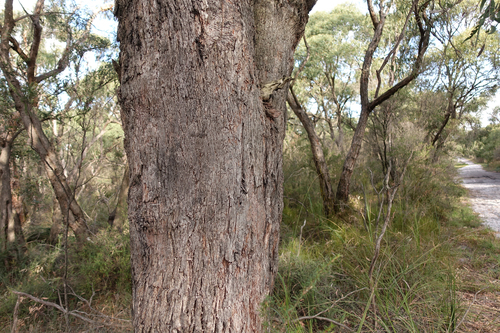
broadleaf peppermint gum
Eucalyptus dives
An aromatic icon of the Australian tablelands, the Broadleaf Peppermint Gum is more than just a tree—it's a thriving high-rise for nectar-hungry birds and climbing marsupials.
Quick Identification
Size
Height of 15-25 metres (50-82 feet) with a trunk diameter up to 1 metre (3.3 feet)
Colors
Grey to brown fibrous bark on trunk; smooth greyish-white bark on upper branches; dull blue-green to grey-green leaves
Key Features
- Rough, finely fibrous 'peppermint' bark on the trunk
- Strong peppermint scent when leaves are crushed
- Broad, lance-shaped or curved adult leaves
- Clusters of 11 or more small white flowers
When You’ll See Them
Geographic range
Where Does the broadleaf peppermint gum Live?
Native to the temperate south-eastern regions of Australia, the Broadleaf Peppermint Gum is a defining feature of the Great Dividing Range. It is primarily found across the eastern and southern tablelands of New South Wales, extending deep into the central and eastern highlands of Victoria. This tree thrives in cooler, elevated climates where it often dominates the canopy on drier slopes and well-drained hillsides.
Basemap © OpenStreetMap contributors
Behavior
The Broadleaf Peppermint Gum is a cornerstone species of the Australian bush, acting as a vital anchor for local ecosystems. While it remains stationary, it is a hive of biological 'behavior,' actively producing high concentrations of essential oils—specifically piperitone—which give the tree its signature scent. These oils serve as a chemical defense against generalist herbivores while making the tree an attractive host for specialized insects and the birds that prey on them.
In the backyard or forest edge, this tree functions as a vertical sanctuary. It is known for its ability to develop hollows as it ages, providing essential nesting sites for a variety of hollow-dependent fauna. During its flowering season, the tree undergoes a dramatic shift in social activity, as its nectar-rich blossoms attract competitive honeyeaters and nocturnal marsupials, creating a 24-hour cycle of wildlife interactions within its canopy.
EverydayEarth exclusive
Camera Tips
To capture the wildlife attracted to a Broadleaf Peppermint Gum, your camera placement should focus on the 'vertical highway' of the trunk. The fibrous, rough bark provides an excellent grip for climbing mammals. Mount your camera 1.5 to 2 metres high on a nearby tree or a sturdy post, angled toward the trunk of the Peppermint Gum. This setup is ideal for capturing Koalas, Sugar Gliders, or Brush-tailed Possums as they navigate the tree at night.
During the flowering months of November to January, the tree becomes a magnet for nectar-feeding birds. To document this, position your camera with a view of lower-hanging blossom clusters. Because Eucalyptus leaves are prone to swaying in the wind, which can trigger hundreds of 'false' videos, set your camera's PIR sensitivity to 'Medium' and use a short trigger interval. This ensures you catch the fast-moving honeyeaters without filling your SD card with wind-blown leaves.
If you have a mature tree with visible hollows, these are prime locations for monitoring. Use an infrared, no-glow flash camera to avoid startling nesting parrots or microbats that emerge at dusk. For the best results, use a 'Time Lapse' mode during the day to capture the slow change of the tree's canopy, or 'Motion Detection' at night to see the secret life of the arboreal mammals that call the Peppermint Gum home.
Similar Species
Species that look similar or are commonly confused with broadleaf peppermint gum.
Frequently Asked Questions
Record broadleaf peppermint gum at your habitat
Connect a camera to start building your own species record — AI identifies every visitor automatically.