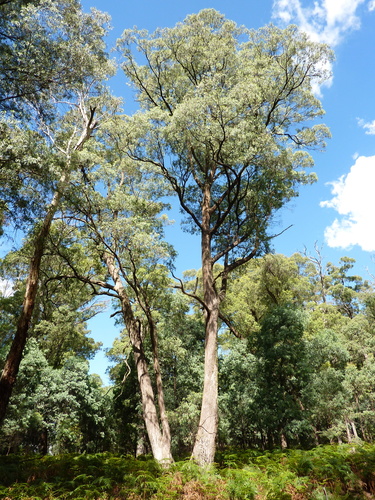
Narrow-leaved Peppermint
Eucalyptus radiata
Famed for its refreshing menthol scent and graceful weeping canopy, the Narrow-leaved Peppermint is a vital pillar of the Australian bush. This hardy eucalypt provides essential food and housing for a vast array of native birds, bees, and marsupials.
Quick Identification
Size
A medium to tall tree reaching 10–30 metres (33–100 feet), occasionally growing to 50 metres (164 feet) in optimal forest conditions.
Colors
Grey-brown fibrous bark on the trunk, smooth light grey bark on upper branches, and dull green foliage.
Key Features
- Rough, finely-fissured 'peppermint' bark that persists on the trunk
- Narrow, lance-shaped leaves that smell strongly of peppermint when crushed
- Flower buds in clusters of 11 to 20+ with white stamens
- Small cup-shaped or hemispherical woody fruit (gumnuts)
When You’ll See Them
Geographic range
Where Does the Narrow-leaved Peppermint Live?
The Narrow-leaved Peppermint is native to the continent of Australia, specifically the temperate south-eastern corner. Its core range spans from the tablelands and coastal ranges of New South Wales into the cooler, high-rainfall regions of Victoria and the Australian Capital Territory. It is particularly prominent in the Southern Highlands and the foothills of the Victorian Alps, where it forms a significant part of the forest canopy.
Basemap © OpenStreetMap contributors
Behavior
The Narrow-leaved Peppermint is a cornerstone of the south-eastern Australian ecosystem, known for its resilience and the refreshing essential oils stored within its leaves. Unlike some eucalypts that shed all their bark, this species retains a thick, fibrous 'stocking' of bark on its trunk which protects it from the heat of bushfires. It is a prolific producer of nectar and pollen, making it a critical resource for local biodiversity during its flowering season in late spring and summer.
In a backyard or woodland setting, this tree acts as a multi-story apartment complex for wildlife. The dense, weeping canopy provides nesting sites for birds, while older specimens naturally develop hollows that offer essential shelter for arboreal mammals and nesting parrots. It is also a primary food tree for several specialized insect species and provides supplementary forage for koalas and gliders.
EverydayEarth exclusive
Camera Tips
When using an AI-powered camera like EverydayEarth, the Narrow-leaved Peppermint is best treated as a 'stage' rather than just a subject. To capture the diversity of wildlife it attracts, mount your camera on a nearby structure or a different tree species about 2-3 metres away, facing a large horizontal branch or the main trunk. This positioning is perfect for spotting Common Ringtail Possums or Sugar Gliders as they navigate the canopy at night.
During the flowering months of October to January, aim your camera towards the clusters of white blossoms on lower-hanging branches. Use a high-speed trigger setting to capture the fast-moving honeyeaters and lorikeets that frequent the flowers for nectar. If your camera is placed in a backyard, ensure it has a clear line of sight to the weeping foliage, as the movement of the narrow leaves in the wind can sometimes trigger PIR sensors—adjust your sensitivity settings accordingly to avoid 'ghost' captures.
Because the bark is highly textured and fibrous, early morning or late afternoon sun (the golden hour) provides the best lighting to showcase the tree’s physical characteristics. The side-lighting emphasizes the grooves in the bark and the silvery sheen of the smooth upper branches. For those interested in insects, a camera with a good macro or close-focus capability placed near a sap-weeping site on the trunk can reveal a hidden world of beetles and native bees.
Similar Species
Species that look similar or are commonly confused with Narrow-leaved Peppermint.
Frequently Asked Questions
Record Narrow-leaved Peppermint at your habitat
Connect a camera to start building your own species record — AI identifies every visitor automatically.