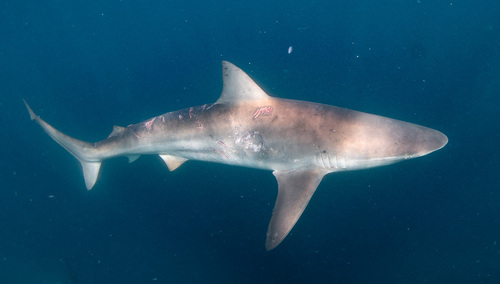
Bronze Whaler
Carcharhinus brachyurus
A sleek, powerful predator of the temperate seas, the Bronze Whaler is famous for its shimmering metallic skin and incredible social hunting displays.
Quick Identification
Size
2.0 to 3.3 metres (6.6 to 11 feet) in length; weighs up to 305 kg (672 lbs)
Colors
Bronze to olive-gray upper body with a metallic copper sheen; pale cream to white underside; fins often have dusky tips
Key Features
- Narrow, hook-shaped upper teeth
- Lack of a prominent ridge between the first and second dorsal fins
- Pointed, moderately long snout
- Large, sickle-shaped pectoral fins
When You’ll See Them
Geographic range
Where Does the Bronze Whaler Live?
The Bronze Whaler is a wide-ranging inhabitant of temperate and subtropical waters across several major oceans. This species thrives in the coastal regions of Australia and New Zealand, as well as along the southern coastlines of Africa from Namibia to KwaZulu-Natal. It is also found in the Mediterranean Sea, parts of the eastern and western Atlantic, and throughout the eastern Pacific from Mexico down to Peru, preferring the nutrient-dense waters of continental shelves.
Basemap © OpenStreetMap contributors
Behavior
The Bronze Whaler is a highly social and active predator, often observed hunting in large, coordinated groups. Unlike many solitary shark species, they frequently gather in hundreds to exploit massive schools of prey, such as during the famous annual Sardine Run off the coast of Southern Africa. Despite their large size and powerful build, they are generally not aggressive toward humans unless food is present, though their sheer size requires caution from divers and swimmers.
These sharks exhibit complex social structures and are known for sexual segregation, where males and females live in separate groups for most of the year, only coming together to mate. They are powerful swimmers and are capable of making long-distance seasonal migrations, often moving toward higher latitudes in the summer to follow cooler, nutrient-rich currents and returning to subtropical waters in the winter.
EverydayEarth exclusive
Camera Tips
Capturing the Bronze Whaler on camera requires a specialized approach since they are marine predators. For the best results, use a Baited Remote Underwater Video (BRUV) system. This involves mounting a high-definition or 4K action camera inside a waterproof housing onto a weighted frame. Position the camera at a slight upward angle (about 10-15 degrees) to capture the shark's silhouette against the surface light, which highlights their distinctive bronze sheen.
To attract these sharks to your camera's field of view, use a perforated bait canister filled with oily fish like mackerel or sardines. Place the rig in 5 to 15 metres of water near rocky reef edges or just outside the surf zone where Bronze Whalers naturally patrol for prey. Early morning and late afternoon provide the best natural lighting, as the low sun angle penetrates the water column without creating harsh glints on the lens.
Because the water can be murky in their preferred temperate habitats, set your camera to a high frame rate (60fps or higher) to capture their swift movements clearly. Ensure your housing is rated for at least twice the depth you intend to deploy at to prevent pressure-related seal failures. In areas with high current, use extra lead weights on your rig to prevent the camera from tumbling across the seafloor.
Similar Species
Species that look similar or are commonly confused with Bronze Whaler.
Frequently Asked Questions
Record Bronze Whaler at your habitat
Connect a camera to start building your own species record — AI identifies every visitor automatically.