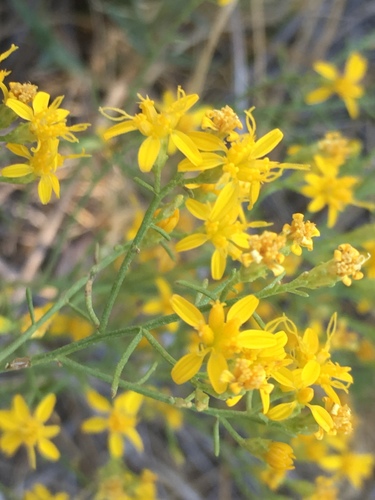
Broom Snakeweed
Gutierrezia sarothrae
A hardy, golden-flowered subshrub that defines the rugged beauty of the American West. Broom Snakeweed provides a vital autumn feast for pollinators while thriving in the harshest desert soils.
Quick Identification
Size
20–90 cm (8–35 in) tall with a similar spread
Colors
Bright golden-yellow flower heads; light green to tan-brown woody stems; dark green linear leaves
Key Features
- Rounded, bushy subshrub with a woody base
- Densely packed clusters of tiny yellow flowers at branch tips
- Resinous, sticky leaves that feel slightly tacky to the touch
- Broom-like appearance with many thin, upright stems
When You’ll See Them
Geographic range
Where Does the Broom Snakeweed Live?
Broom Snakeweed is a hallmark of the vast landscapes of Western North America. Its native territory stretches from the prairie provinces of western Canada, such as Alberta and Saskatchewan, southward through the Great Plains and the Intermountain West of the United States. Its range extends deep into northern Mexico, where it is a common sight across the Chihuahuan, Sonoran, and Mojave deserts, often dominating sun-drenched, open terrain.
Basemap © OpenStreetMap contributors
Behavior
During the late summer and autumn, the plant undergoes a dramatic transformation, covering itself in a dense mantle of small yellow blooms. This flowering period is a hive of activity, as the plant serves as a critical late-season food source for various native bees, butterflies, and beetles. Despite its beauty, the plant produces saponins and terpenes, which serve as a chemical defense mechanism, making it unpalatable and potentially toxic to livestock like cattle and sheep.
EverydayEarth exclusive
Camera Tips
If you are interested in the 'wildlife' aspect of this plant, focus on its role as a pollinator magnet. Position your camera about 2 feet away from a healthy, blooming specimen. Use a high-speed trigger setting to capture the rapid movements of visiting butterflies, such as the Common Checkered-Skipper, or native plasterer bees. The resinous leaves can be quite reflective, so try to position the camera so the sun is at a 45-degree angle to the plant; this avoids harsh glares while highlighting the sticky texture of the foliage.
For backyard enthusiasts in arid regions, Broom Snakeweed provides an excellent backdrop for ground-dwelling animals. Small mammals like desert cottontails or ground squirrels often use the dense, woody base for cover. Placing a camera near a stand of Snakeweed during the early morning (6-9 AM) can capture these animals as they emerge from the shrub's protection. Ensure your camera's white balance is set to 'Daylight' to accurately capture the vivid saturation of the yellow flowers, which can sometimes look washed out under 'Auto' settings.
Similar Species
Species that look similar or are commonly confused with Broom Snakeweed.
Frequently Asked Questions
Record Broom Snakeweed at your habitat
Connect a camera to start building your own species record — AI identifies every visitor automatically.