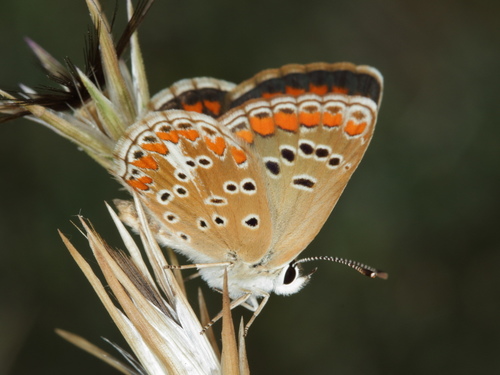
Brown Argus
Aricia agestis
A chocolate-colored jewel of the grassland, the Brown Argus is a master of the low-altitude dash. Once restricted to chalky hills, this adaptable butterfly is now a frequent and welcome visitor to sunny backyard gardens.
Quick Identification
Size
Wingspan of 25–31 mm (1.0–1.2 inches); body length approximately 12–15 mm
Colors
Upperwings are a deep chocolate brown with a distinctive row of orange sun-shaped crescents at the edges. Undersides are pale greyish-brown with white-ringed black spots.
Key Features
- Solid chocolate-brown upperwings with orange border lunules
- No blue scales at the wing base (unlike female Common Blue)
- Two spots on the underside of the hindwing form a 'figure-of-eight' pattern
- White fringe around wing margins is not checkered
When You’ll See Them
Geographic range
Where Does the Brown Argus Live?
The Brown Argus is native to the Palearctic realm, stretching across Europe and temperate Asia. It is a common sight throughout southern and central England and Wales, with its range extending through mainland Europe into Siberia and the Tian Shan mountains. In recent years, it has notably expanded its northern boundaries in the UK and Scandinavia, adapting to new habitats and host plants in response to a warming climate.
Basemap © OpenStreetMap contributors
Behavior
The Brown Argus is a sun-loving butterfly known for its low, darting flight. Unlike more migratory species, it is quite sedentary, often spending its entire life cycle within a small patch of favorable habitat. They are most frequently observed basking in the sun on bare ground or low-lying leaves to regulate their body temperature, holding their wings open to catch the maximum amount of light.
During the day, they are active nectar-feeders, visiting a variety of low-growing wildflowers. As dusk approaches or during periods of overcast weather, they exhibit a characteristic roosting behavior where they rest head-downwards on tall grass stems. While they are generally solitary, you might find several individuals in close proximity if a particular garden patch is rich in their favorite larval food plants, such as Cranesbill.
EverydayEarth exclusive
Camera Tips
Capturing the Brown Argus on a backyard camera requires a focus on low-level activity. Because these butterflies rarely fly higher than a meter off the ground, set your camera on a short tripod or ground mount. Position the lens near nectar-rich plants like Bird's-foot-trefoil or wild Geranium. For the best AI detection, aim the camera at a patch of flowers that sits in full sun, as the Brown Argus is most active and likely to land when the temperature is high.
To get professional-looking shots, try to position your camera so the sun is behind it or to the side; this highlights the rich chocolate color and the orange 'lunules' on the wing edges. If your camera has a macro mode or a close-focusing lens, use it—this species is small, and a standard wide-angle trail cam might lose the detail of its intricate 'figure-of-eight' spot pattern. A high frame rate or 'burst' mode is also helpful to capture the moment they transition from basking to flight.
Early morning is a 'secret' window for photography. Before they have enough thermal energy to fly, you can find them resting on grass stems. During this time, you can move your camera much closer without triggering a flight response. If you use a camera with a motion trigger, set the sensitivity to high, as the small mass of a butterfly may not always trip PIR sensors designed for larger mammals.
Similar Species
Species that look similar or are commonly confused with Brown Argus.
Frequently Asked Questions
Record Brown Argus at your habitat
Connect a camera to start building your own species record — AI identifies every visitor automatically.