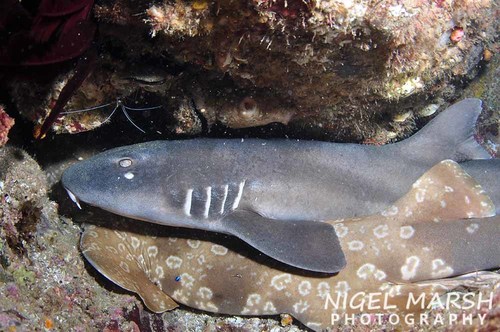
Brown-banded Bamboo Shark
Chiloscyllium punctatum
Meet the 'walking' shark of the Indo-Pacific reefs. The Brown-banded Bamboo Shark is a fascinating, docile nocturnal hunter that navigates tide pools with ease and sports striking stripes in its youth.
Quick Identification
Size
Adults typically reach 60-104 cm (24-41 inches) in length; newborns are 13-18 cm (5-7 inches).
Colors
Adults are a uniform light brown or tan, occasionally with faint bands; juveniles have high-contrast dark brown and cream-white vertical bands with scattered black spots.
Key Features
- Long, thick tail that exceeds the length of the rest of the body
- Distinctive dark and light bands on juveniles that fade with age
- Pair of sensory barbels near the mouth used for foraging
- Two dorsal fins located far back on the body
- Muscular pectoral fins used for 'walking' along the seafloor
When You’ll See Them
Geographic range
Where Does the Brown-banded Bamboo Shark Live?
The Brown-banded Bamboo Shark is native to the warm tropical waters of the Indo-West Pacific region. Its core range extends from the southern coasts of Japan down through Southeast Asia, including the Philippines, Indonesia, and Thailand, reaching as far south as the northern coast of Australia. This shark thrives in the shallow coastal fringes of the Coral Triangle and is frequently found in the intertidal zones of these regions, though it has also been recorded in deeper waters off the continental shelf.
Basemap © OpenStreetMap contributors
Behavior
The Brown-banded Bamboo Shark is a remarkably sedentary and docile species, often described as a 'bottom-dweller' due to its habit of resting on the seafloor or hiding within reef crevices during the day. Unlike many of its larger relatives, this shark does not need to swim constantly to breathe; it uses a specialized pumping mechanism to move oxygenated water over its gills, allowing it to remain perfectly still for hours. This behavior makes it a favorite for underwater observers and aquarium enthusiasts alike.
When night falls, the shark becomes a dedicated nocturnal hunter. It uses its flexible body and muscular fins to navigate tight spaces between corals, essentially 'walking' across the substrate rather than swimming. Socially, they are relatively solitary but are often found in high densities in areas with abundant food, showing little aggression toward other members of their species. To humans, they are entirely harmless and generally shy, preferring to retreat into a hole rather than confront a diver.
EverydayEarth exclusive
Camera Tips
To capture high-quality footage of a Brown-banded Bamboo Shark, you will need a waterproof action camera or a trail camera with a high-quality underwater housing. Because these sharks are strictly nocturnal, standard cameras will only capture silhouettes or darkness. We recommend using a camera equipped with infrared or red-light LEDs. Marine life, including these sharks, is significantly less sensitive to red light, meaning you can illuminate the scene without scaring the shark away or disrupting its natural foraging behavior.
Placement is key for this bottom-dwelling species. Secure your camera to a weighted base or a low-profile tripod and position it on a sandy patch immediately adjacent to a known reef hideout or under a rock ledge. Angle the lens slightly upward to capture the shark's profile as it 'walks' by. If you are setting up in a tide pool, ensure the camera is deployed during the outgoing tide so it remains submerged and stable while the shark is most likely to be trapped in the shallower water for easy viewing.
Using a scent lure is the most effective way to bring a Brown-banded Bamboo Shark into your camera's frame. Place a small mesh bag containing crushed shrimp, squid, or oily fish like sardines about 12 to 18 inches in front of the lens. The shark's sensitive barbels will pick up the scent trail from a distance, leading it directly to the 'sweet spot' of your camera's focus. Unlike larger sharks that might bite and swim away, bamboo sharks will often linger and vacuum at the scent bag, providing long, clear sequences of their unique feeding mechanics.
Check your local tide charts and aim for nights with a rising tide shortly after dusk. These sharks often follow the incoming tide into very shallow areas to hunt for crustaceans that have become active in the new water. Set your camera to record in 1-2 minute intervals with a high sensitivity trigger if available, or use a continuous loop recording if the battery life allows. Because they move slowly, a frame rate of 30fps is usually sufficient, but high-definition resolution is preferred to see the intricate patterns on their skin.
Similar Species
Species that look similar or are commonly confused with Brown-banded Bamboo Shark.
Frequently Asked Questions
Record Brown-banded Bamboo Shark at your habitat
Connect a camera to start building your own species record — AI identifies every visitor automatically.