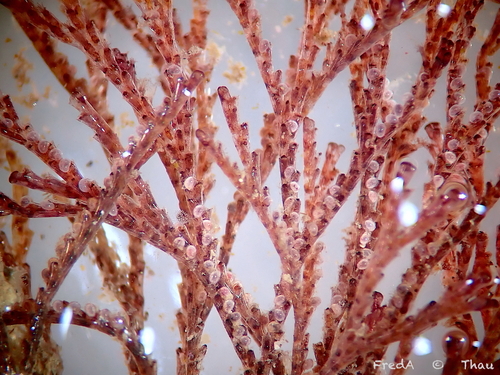
brown bryozoan
Bugula neritina
The Brown Bryozoan is a master of the underwater world, forming intricate, purple-tinged colonies that look more like seafaring shrubs than animals. A global traveler found in harbors everywhere, this 'moss animal' is a vital subject for anyone exploring backyard marine life.
Quick Identification
Size
Colonies typically grow 5–10 cm (2–4 inches) in height, forming bushy tufts that can merge into dense mats covering several square feet.
Colors
Deep reddish-brown, purplish-brown, or dark maroon; individual zooids are translucent but appear dark due to colony density.
Key Features
- Bushy, upright branching structure resembling a small shrub
- Dark reddish-brown to purple coloration
- Bifurcating (Y-shaped) branches with double rows of zooids
- Sessile attachment to hard substrates like docks and hulls
When You’ll See Them
Geographic range
Where Does the brown bryozoan Live?
Where Does the Brown Bryozoan Live? Originally native to the Mediterranean Sea and the North Atlantic, the Brown Bryozoan has successfully spread to every continent except Antarctica. It is now a cosmopolitan species, with massive established populations along the Atlantic and Pacific coasts of the United States, the shores of the United Kingdom, and throughout the coastal waters of Australia, Japan, and China. Because it hitches rides on the hulls of commercial ships, it is a common sight in almost every major temperate and tropical port worldwide.
Basemap © OpenStreetMap contributors
Behavior
The Brown Bryozoan is a colonial organism comprised of thousands of microscopic individuals called zooids. While it may look like a plant or seaweed, it is actually a highly organized animal colony. Each zooid lives within a tiny box-like chamber and possesses a lophophore—a crown of ciliated tentacles used to filter food from the water. They are known as 'biofoulers' because they are among the first organisms to colonize new underwater surfaces, often creating thick blankets that provide habitat for other small marine creatures.
These organisms do not move from their attachment point once settled as larvae. Instead, they exhibit complex collective behavior by coordinating the retraction of their feeding tentacles in response to predators or physical disturbance. Interestingly, Bugula neritina is famous in the scientific community for its symbiotic relationship with the bacteria 'Candidatus Endobugula sertula,' which produces chemical compounds called bryostatins. these chemicals protect the larvae from being eaten by fish, making the colony naturally repellent to many predators.
EverydayEarth exclusive
Camera Tips
To capture the Brown Bryozoan on camera, you will need a waterproof setup or an underwater housing. Because these colonies are sessile and found in shallow water, they are perfect subjects for backyard marine enthusiasts with access to a dock or pier. Mounting your camera to a weighted PVC frame or a specialized pier-mount allows you to position the lens just inches away from the colony. Aim for a side-on angle to capture the intricate, bushy branching structure against the water column.
Lighting is the most critical factor for a clear shot. Underwater environments, especially under docks, are notoriously dark and can make the Brown Bryozoan look like a murky brown blob. Use an external LED dive light positioned at a 45-degree angle to the colony. This side-lighting will highlight the purplish hues and the individual zooid structures that are otherwise lost in flat light. If you are filming in a tide pool, midday sun can provide natural light, but beware of surface reflections.
For truly professional results, use a time-lapse setting. Over the course of an hour, a time-lapse will reveal the 'breathing' of the colony—the subtle emergence and retraction of thousands of microscopic lophophores as they react to water currents and passing particles. Because the colony doesn't move, you can use a very slow shutter speed to capture high-detail images. Ensure your mount is rock-steady, as even minor wave action can cause motion blur in macro shots.
Keep an eye on the water clarity. The best footage is captured after a few days of calm weather when suspended sediment has settled. If you are placing a camera in a high-traffic harbor, check the lens every 24 hours, as the Brown Bryozoan or its cousins might actually try to grow on your camera housing! Using a macro lens attachment is highly recommended to see the individual chambers of the zooids, which provides a fascinating 'alien world' perspective to your viewers.
Similar Species
Species that look similar or are commonly confused with brown bryozoan.
Frequently Asked Questions
Record brown bryozoan at your habitat
Connect a camera to start building your own species record — AI identifies every visitor automatically.