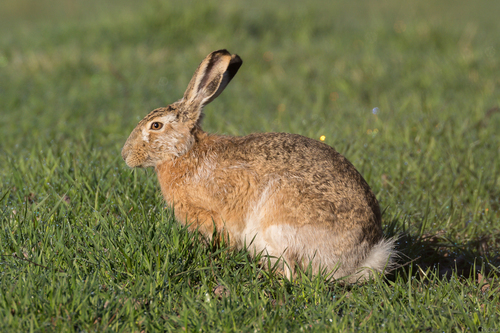
Brown Hare
Lepus europaeus
Meet the sprinter of the grasslands. With their iconic black-tipped ears and lightning-fast reflexes, Brown Hares are a masterclass in mammalian speed and camouflage.
Quick Identification
Size
Length: 50–70 cm (20–28 in); Weight: 2.5–7 kg (5.5–15 lb)
Colors
Golden-brown or tawny fur with a white underside; ears are pale grey with distinct black tips; tail is black on top and white underneath.
Key Features
- Very long ears with prominent black tips
- Large, powerful hind legs built for sprinting
- Deep amber or golden eyes
- Loping, high-speed gait
- Larger and more 'leggy' than a common rabbit
When You’ll See Them
Geographic range
Where Does the Brown Hare Live?
Native to the temperate landscapes of Europe and Western Asia, the Brown Hare is a hardy survivor found from the United Kingdom across to the Russian Steppes. They are most abundant in the lowland agricultural regions of countries like France, Germany, and the UK, where open fields provide ample grazing. Beyond their native range, they have been successfully introduced to North America, parts of South America, and Australia, where they occupy similar open-country niches.
Basemap © OpenStreetMap contributors
Behavior
Brown Hares are solitary animals that do not live in burrows like rabbits. Instead, they spend their days resting in a 'form,' which is a shallow depression in the ground or among long grass. They rely on their incredible camouflage to stay hidden, only bolting at the last possible second when a predator approaches. When they do run, they are capable of reaching speeds up to 45 mph (70 km/h) in a zigzag pattern to outmaneuver threats.
During the spring, their behavior becomes famously erratic, leading to the phrase 'Mad as a March Hare.' This involves 'boxing' matches where hares stand on their hind legs and strike each other with their paws. Interestingly, this isn't usually two males fighting, but rather a female (doe) fending off the unwanted advances of a persistent male (buck). While they are generally shy and avoid human contact, they have adapted well to agricultural landscapes and can occasionally be spotted in large suburban gardens bordering open fields.
EverydayEarth exclusive
Camera Tips
To capture a Brown Hare on camera, placement is everything. These animals are creatures of habit and will often use the same 'runs' or paths through long grass or under hedgerows. Look for 'smouts'—small gaps at the base of fences or gates—and position your camera about 12 to 18 inches off the ground. Angling the camera slightly downward will help ensure you catch their full profile rather than just their long ears as they pass by.
Timing is crucial for hare photography. Because they are crepuscular (active at dawn and dusk) and nocturnal, you need a camera with excellent low-light performance and a fast trigger speed. Hares move quickly, and a slow trigger will result in a series of 'empty' photos or just a blurred tail. Using a 'no-glow' or 'black' infrared flash is highly recommended; while hares aren't as easily spooked as some predators, a bright red glow can make them avoid that specific path in the future.
In a backyard setting, you can encourage visits by maintaining a patch of clover or leaving a section of your lawn to grow long. Unlike rabbits, hares aren't easily tempted by bait piles, but they are attracted to the salt in some lick blocks or the fresh growth of vegetable patches. If you are setting up a trail cam in a field, try to find a 'form' (their resting spot). Setting the camera to take a short video (10-15 seconds) is often more rewarding than photos, as it allows you to see their characteristic grooming behavior and ear-twitching.
Similar Species
Species that look similar or are commonly confused with Brown Hare.
Frequently Asked Questions
Record Brown Hare at your habitat
Connect a camera to start building your own species record — AI identifies every visitor automatically.