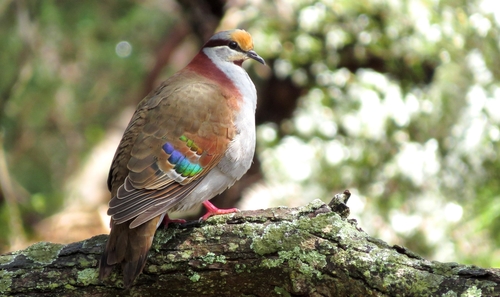
Brush Bronzewing
Phaps elegans
With its shimmering metallic wings and rich chestnut plumage, the Brush Bronzewing is a hidden gem of the Australian scrub. This elusive ground-dweller is a favorite for backyard observers who appreciate the subtle beauty of native pigeons.
Quick Identification
Size
25-33 cm (10-13 inches) in length; 160-240g (5.6-8.5 oz) in weight
Colors
Rich chestnut and rufous on the nape and wings; blue-grey underparts; iridescent metallic wing patches (bronze, green, violet); males have a buff forehead and deeper chestnut throat.
Key Features
- Iridescent metallic wing patches
- Rich chestnut-rufous patch on the back of the neck and throat
- Buff-colored forehead (more prominent in males)
- Compact, stocky build with a relatively short tail
When You’ll See Them
Geographic range
Where Does the Brush Bronzewing Live?
The Brush Bronzewing is a native inhabitant of the Australian continent, occupying the temperate coastal and sub-coastal fringes. Its distribution is split into two distinct populations: one found in the southwest corner of Western Australia, and the other stretching from south-eastern South Australia through Victoria, eastern New South Wales, and across the island state of Tasmania. While they are occasionally seen near suburban fringes, they are most successful in areas with undisturbed dense heath and forest understory.
Basemap © OpenStreetMap contributors
Behavior
The Brush Bronzewing is a notoriously shy and elusive bird, often heard before it is seen. Unlike its more gregarious cousin, the Common Bronzewing, this species prefers the sanctuary of dense undergrowth and rarely ventures far into the open. When disturbed, it stays low to the ground until the last possible moment, then explodes into flight with a characteristic loud, metallic clapping of wings, usually banking sharply into thick cover.
They are primarily terrestrial birds, spending the vast majority of their day foraging on the ground for seeds. While they are usually solitary or found in pairs, they may congregate in small numbers around water sources during dry spells. Their social interactions are subtle, often involving quiet 'oom' calls that are low-pitched and carry surprisingly well through the scrub.
EverydayEarth exclusive
Camera Tips
To capture the elusive Brush Bronzewing, camera placement is everything. Because they are ground-dwelling specialists that avoid open spaces, position your camera just 10 to 15 centimeters (4-6 inches) off the ground, aimed toward a clear patch of leaf litter near dense cover. Look for 'corridors' where the scrub meets a forest track or a small opening; these birds love to skulk along the edges. A wide-angle lens is preferred as they often walk quite close to the camera while foraging.
Water is the best natural lure for this species. In drier months, placing a shallow birdbath or a slow-dripping water feature in a quiet, shaded corner of your garden can provide incredible footage. Ensure the water source is near thick bushes so the birds feel safe enough to emerge. If you are using bait, a scatter of native seeds or a high-quality wild bird mix containing small grains like millet can encourage them to linger in the frame for longer periods.
Since Brush Bronzewings are most active during the cooler parts of the day, set your camera for high sensitivity during the early morning and late afternoon. They are extremely sensitive to movement and noise, so if your camera has a 'silent' mode or no-glow infrared LEDs, use them to avoid spooking the bird. Rapid-fire burst mode is excellent for capturing their iridescent wing colors, which change dramatically from bronze to green to violet depending on the angle of the light.
Similar Species
Species that look similar or are commonly confused with Brush Bronzewing.
Frequently Asked Questions
Record Brush Bronzewing at your habitat
Connect a camera to start building your own species record — AI identifies every visitor automatically.