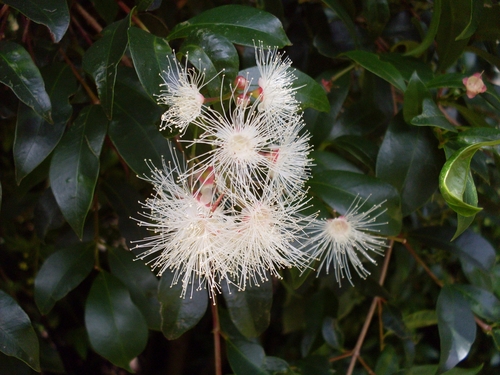
Brush Cherry
Syzygium paniculatum
A vibrant Australian rainforest native, the Brush Cherry is a wildlife magnet famous for its glossy evergreen leaves and stunning magenta fruit. Whether it's a wild giant or a backyard hedge, this tree provides a vital sanctuary for nectar-lovers and fruit-eaters alike.
Quick Identification
Size
Typically grows to 15 metres (49 feet) in cultivation, though wild specimens can reach 35 metres (115 feet) with a 35 cm trunk diameter.
Colors
Dark glossy green upper leaves with paler undersides; new growth often bronze-pink; fluffy white flowers; magenta, purple, or white fruit.
Key Features
- Dense, bushy rainforest growth habit
- Glossy, opposite, obovate leaves tapering at the base
- Large clusters of white flowers with prominent stamens
- Edible pear-shaped magenta fruit containing polyembryonic seeds
When You’ll See Them
Geographic range
Where Does the Brush Cherry Live?
The Brush Cherry is native to the narrow coastal strip of New South Wales, Australia, where it thrives in the humid conditions of the rainforest fringe. While its wild populations are restricted and considered vulnerable, it has become a global citizen through horticulture. Today, you can find the Brush Cherry throughout mainland Australia and in many subtropical and temperate regions across the world, including significant populations in California and the North Island of New Zealand.
Basemap © OpenStreetMap contributors
Behavior
The Brush Cherry is a versatile and hardy rainforest tree that serves as a vital 'anchor species' in both wild and suburban ecosystems. While it is a stationary plant, its biological rhythm dictates the activity of dozens of other species. During the spring, it produces a spectacular display of white, fluffy flowers that act as a high-octane fuel station for bees, butterflies, and nectar-feeding birds. As these flowers transition into fruit, the tree becomes a bustling hub for larger birds and mammals.
In a garden setting, the Brush Cherry is prized for its 'plasticity'—its ability to be pruned into tight, dense hedges. This density is more than just an aesthetic choice; it provides a nearly impenetrable fortress for small birds like wrens and finches to hide from hawks and cats. The tree's deep root system and evergreen nature make it a stable, year-round resident that can withstand a variety of environmental pressures once established.
EverydayEarth exclusive
Camera Tips
To capture the incredible diversity of life the Brush Cherry supports, your camera placement should focus on the 'fruit zones.' Mount your AI-powered camera 5 to 8 feet high on a nearby post or a sturdy internal branch, angling it downward toward a cluster of ripening magenta berries. This positioning is perfect for identifying visiting King Parrots, Crimson Rosellas, and Figbirds. For the best results, ensure the sun is behind the camera to avoid 'silhouetting' the birds against the bright sky visible through the canopy gaps.
If you are interested in nocturnal visitors, the Brush Cherry is a premier location to spot Grey-headed Flying Foxes and various species of possums. Use a camera with a fast trigger speed and high-quality infrared night vision. Because the leaves of the Brush Cherry are extremely glossy, infrared light can sometimes cause a 'white-out' glare on your photos. To prevent this, angle the camera slightly to the side (about 30-45 degrees) rather than pointing it directly at a wall of foliage.
For ground-dwelling wildlife, consider placing a second camera near the base of the tree. During peak fruiting season, many animals will forage for fallen berries on the ground. This is a great way to capture more elusive species like the Superb Lyrebird in wilder areas or Australian Brush-turkeys in suburban zones. Set your camera to 'Video' or 'Burst Mode' with a short interval, as the movement of birds in the branches can be very rapid and might trigger the sensor multiple times in quick succession.
Similar Species
Species that look similar or are commonly confused with Brush Cherry.
Frequently Asked Questions
Record Brush Cherry at your habitat
Connect a camera to start building your own species record — AI identifies every visitor automatically.