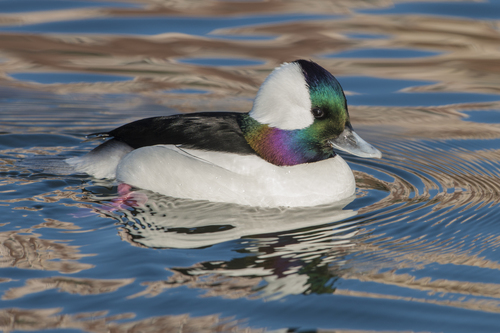
Bufflehead
Bucephala albeola
The Bufflehead is a tiny, energetic jewel of the waterfront. With their striking iridescent heads and remarkable diving abilities, these 'spirit ducks' are a winter highlight for any backyard observer.
Quick Identification
Size
Smallest diving duck in North America; Length: 32–40 cm (12.5–15.5 in); Wingspan: 55 cm (21.6 in); Weight: 270–450 g (9.5–15.8 oz)
Colors
Males have a black back and white body with a large white patch on a dark, iridescent green and purple head. Females are drabber, with a gray-brown body and a distinctive white oval patch on their dark brown cheeks.
Key Features
- Tiny, compact body with a disproportionately large 'buffalo' head
- Male has a large white wedge-shaped patch covering the back of the head
- Female has a characteristic white oval cheek patch
- Short, grayish-blue bill
- Rapid, frequent diving behavior without a splash
When You’ll See Them
Geographic range
Where Does the Bufflehead Live?
The Bufflehead is native to North America, maintaining a vast migratory range that spans from the Arctic to the subtropics. They spend their breeding season in the boreal forests and parklands of Alaska and Canada, particularly in British Columbia and Alberta. During the winter, they migrate south to occupy the ice-free waters of the United States and northern Mexico, appearing on both the Atlantic and Pacific coasts as well as many interior waterways.
Basemap © OpenStreetMap contributors
Behavior
Buffleheads are high-energy diving ducks that seem to be in constant motion. They are famous for their rapid diving, disappearing underwater to forage for insects and crustaceans and popping back up like a cork. Unlike many ducks that require a long running start to fly, the Bufflehead can take off directly from the water's surface with incredible speed, a trait that helps them escape predators.
These ducks are unique among waterfowl for their monogamous social structure, often staying with the same mate for several years. They are also highly dependent on Northern Flickers, as they almost exclusively nest in old woodpecker holes. While they are generally shy around humans, they are frequent visitors to suburban ponds during the winter months, provided there is enough cover and minimal disturbance.
EverydayEarth exclusive
Camera Tips
To capture high-quality footage of Buffleheads, camera placement is everything. These small ducks stay close to the water, so mount your camera on a low-profile stake or a floating platform just 6 to 12 inches above the waterline. Aim your lens toward shallow areas where you see them frequenting; they often have 'favorite' spots in a pond where they return to dive. Because they are incredibly fast, ensure your camera is set to its highest possible frame rate—at least 60fps—to avoid motion blur during dives and takeoffs.
Subtlety is key when dealing with Buffleheads. Use a camera with a matte, non-reflective finish or apply camouflage tape to the housing. They have excellent eyesight and will avoid areas where a strange, shiny object has recently appeared. If you are using a trail camera, set the trigger interval to the shortest possible time, as these ducks often surface, shake their feathers, and dive again within seconds. Natural light is your best friend here; early morning sun hitting their iridescent heads creates a stunning rainbow effect that IR night vision simply can't capture.
If you live in a cold climate, place your camera near 'air holes' or patches of open water in frozen ponds. Buffleheads are often the last to leave and first to return as the ice shifts, and they will congregate in these small openings. Be mindful of the exposure settings; the bright white patches on the male can easily become 'blown out' or overexposed against dark water, so if your camera allows for exposure compensation, dial it down slightly to preserve the detail in their plumage.
Similar Species
Species that look similar or are commonly confused with Bufflehead.
Hooded Merganser
Larger with a thin, serrated bill and a circular white patch on a tall crest rather than a wedge patch on the back of the head.
Common Goldeneye
Significantly larger with a circular white spot in front of the eye (near the bill) rather than a large patch behind the eye.
Ruddy Duck
Similar size but has a stiff, upright tail and a much thicker, bright blue bill during the breeding season.
Frequently Asked Questions
Record Bufflehead at your habitat
Connect a camera to start building your own species record — AI identifies every visitor automatically.