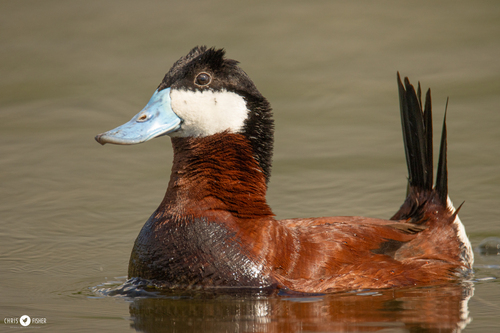
Ruddy Duck
Oxyura jamaicensis
Famous for its vibrant sky-blue bill and its habit of cocking its tail like a wren, the Ruddy Duck is the small, spunky star of North American wetlands.
Quick Identification
Size
Length: 35–43 cm (14–17 in); Wingspan: 56–62 cm (22–24 in); Weight: 310–795 g (11–28 oz)
Colors
Breeding males feature a brilliant sky-blue bill, rich chestnut-red body, black cap, and white cheek patches. Females and non-breeding males are a mottled dusty brown with a dark cap and a single dark stripe across a pale cheek.
Key Features
- Long, stiff tail often held upright at an angle
- Bright sky-blue bill on breeding males
- Large white cheek patch contrasting with a black cap
- Chunky, compact body with a thick, short neck
When You’ll See Them
Sightings on EverydayEarth
May 25, 2026
A small waterbird, a Ruddy Duck, swims steadily across the calm surface of the spring. It is visible in the upper portion of the frame, moving from right to left with its signature stiff tail held upright.
Geographic range
Where Does the Ruddy Duck Live?
Native to North and Central America, the Ruddy Duck's core breeding range spans from the prairie pothole regions of southern Canada and the western United States down into Mexico. During the winter months, they migrate toward the ice-free coasts of the Atlantic, Pacific, and Gulf of Mexico, as well as throughout much of Central America. While they are a staple of American wetlands, an introduced population in the United Kingdom and parts of Europe has become a point of ecological concern due to their invasive nature and competition with native species.
Basemap © OpenStreetMap contributors
Behavior
The Ruddy Duck is a charismatic member of the 'stiff-tailed' duck group, best known for its comical and energetic courtship displays. During the spring, males perform a unique 'bubble display' where they rapidly beat their bills against their inflated necks, forcing air through their feathers to create a spray of bubbles and a low, drumming sound. Because their legs are positioned far back on their bodies for efficient diving, they are incredibly clumsy on land and rarely leave the water except to nest.
These ducks are proficient divers, disappearing under the surface with a silent, sleek motion to forage on the muddy bottoms of ponds. Unlike many other duck species that take flight when startled, Ruddy Ducks often prefer to dive or swim away into dense vegetation. They are generally social outside of the breeding season, forming small rafts on open water, though males can be quite aggressive toward other waterfowl when defending their territory.
EverydayEarth exclusive
Camera Tips
To successfully capture Ruddy Ducks on camera, you must focus on the water's edge. Because these ducks sit very low in the water and almost never walk on land, a camera mounted high on a bank will likely only capture the tops of their heads. For the best angle, mount your camera just 6 to 12 inches above the water line. Using a post or a floating dock mount is ideal to get that intimate, eye-level perspective that makes the male's blue bill really pop.
Since Ruddy Ducks are divers and find their food on the bottom of the pond, traditional surface baits like corn or birdseed are rarely effective. Instead, place your camera near 'bottlenecks' in the habitat—such as small channels between patches of reeds or the edges of lily pad fields. They are creatures of habit and will often use the same protected alcoves to rest and preen during the midday hours.
For AI-powered cameras, set your trigger sensitivity to high. Ruddy Ducks are small and move with a low profile; if the camera is too far away, it might not register the motion. If your camera supports it, use 'Burst Mode' or high-speed video. The male's courtship behavior, including the bill-slapping and bubble-blowing, happens very quickly and is the 'holy grail' shot for backyard observers. Position your camera facing north or south to avoid lens flare from the rising or setting sun, which is when they are most active.
Similar Species
Species that look similar or are commonly confused with Ruddy Duck.
Frequently Asked Questions
Record Ruddy Duck at your habitat
Connect a camera to start building your own species record — AI identifies every visitor automatically.