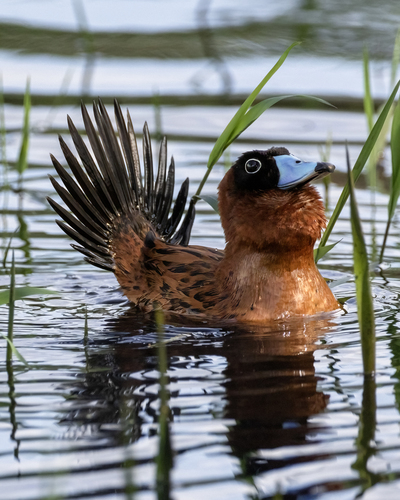
Masked Duck
Nomonyx dominicus
A master of disappearance, the Masked Duck is the ultimate prize for wetland observers. With its striking cinnamon plumage and secretive nature, this tiny 'stiff-tail' brings a touch of tropical mystery to the water's edge.
Quick Identification
Size
Length 30–36 cm (12–14 in); wingspan 45–55 cm (18–22 in); weight 275–450 g (9.7–15.9 oz)
Colors
Breeding males have a bright rusty-cinnamon body with a solid black face mask and a bright blue bill. Females and non-breeding males are buffy-brown with two distinct dark horizontal stripes across a pale face.
Key Features
- Solid black face mask (breeding male)
- Two dark horizontal facial stripes (female/immature)
- Spiky, stiff tail often held upright or submerged
- Compact, stocky body with a bright blue bill in males
- Skulking behavior in dense aquatic vegetation
When You’ll See Them
Geographic range
Where Does the Masked Duck Live?
The Masked Duck is native across the tropical Americas, with a vast home range extending from the Caribbean islands and Central America through much of South America as far south as northern Argentina. In the United States, they are considered rare and nomadic visitors, primarily appearing in the freshwater wetlands of southern Texas and occasionally Florida. Because of their nomadic nature, they often appear suddenly in new territories following heavy rainfall or changes in local water levels, disappearing just as quietly when conditions change.
Basemap © OpenStreetMap contributors
Behavior
The Masked Duck is one of the most secretive waterfowl species in the Americas. Unlike many ducks that take flight when startled, the Masked Duck prefers to sink slowly into the water or swim quietly into dense reeds to disappear. They are masters of camouflage, often sitting motionless among water lilies or hyacinths for long periods, making them incredibly difficult to spot even when they are only a few feet away.
These birds are primarily aquatic and are quite clumsy on land due to their legs being set far back on their bodies—an adaptation that makes them excellent divers. They are generally solitary or found in small family groups rather than large flocks. While they are capable of strong flight, they usually fly low over the water's surface, rarely venturing far from the safety of thick cover.
EverydayEarth exclusive
Camera Tips
To capture the elusive Masked Duck on camera, placement is everything. These ducks rarely leave the water, so position your camera at a very low angle, ideally just a few inches above the water line on a sturdy dock or a partially submerged post. Focus your lens on small openings or 'lanes' within floating vegetation like water lilies or hyacinths, as these are the paths the ducks use to navigate through cover.
Because they are most active during the low-light hours of dawn and dusk, ensure your camera has a high-quality sensor capable of handling low light without excessive noise. A fast trigger speed is less important than a silent shutter; these birds are incredibly sensitive to noise and will submerge and vanish if they hear mechanical clicking. Setting your camera to a multi-shot burst mode can help you capture the perfect moment when they momentarily lift their stiff tails out of the water.
Standard birdseed won't work for these specialists. If you are trying to encourage them to stay in an area, maintain a healthy wetland ecosystem with plenty of native aquatic plants. They are attracted to quiet, undisturbed water. Avoid high-traffic areas, as the presence of pets or frequent human movement will keep them hidden in the densest reeds where your camera cannot see them.
Similar Species
Species that look similar or are commonly confused with Masked Duck.
Frequently Asked Questions
Record Masked Duck at your habitat
Connect a camera to start building your own species record — AI identifies every visitor automatically.