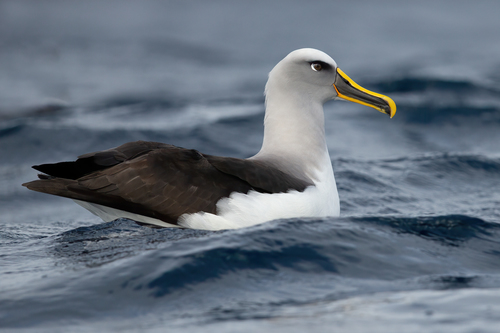
Buller's Albatross
Thalassarche bulleri
A silver-capped mariner of the Southern Ocean, Buller's Albatross is a testament to the endurance of nature. These magnificent gliders spend their lives navigating the winds between New Zealand and South America.
Quick Identification
Size
Length: 76-81 cm (30-32 in); Wingspan: 200-213 cm (79-84 in); Weight: 2.0-3.4 kg (4.4-7.5 lbs)
Colors
Silver-grey forehead and crown with a darker grey mask around the eyes; dark grey-brown upperwings and back; white underparts and underwings with a thin black margin; bill is black with bright yellow/orange ridges.
Key Features
- Silver-grey 'cap' contrasting with white underparts
- Black bill with vivid yellow horizontal stripes on the top and bottom
- Narrow black borders on the underside of the wings
- Medium-sized mollymawk with a dark grey 'saddle' across the back
When You’ll See Them
Geographic range
Where Does the Buller's Albatross Live?
Native to the southwestern Pacific, Buller's Albatross is most commonly associated with the waters surrounding New Zealand. They primarily breed on the Snares and Solander Islands, as well as the Chatham Islands, before embarking on an incredible trans-Pacific migration. During the non-breeding season, these birds are frequently sighted along the Humboldt Current off the coasts of Chile and Peru in South America.
Basemap © OpenStreetMap contributors
Behavior
Buller's Albatross is a master of dynamic soaring, a flight technique that allows it to travel vast distances across the Southern Ocean with minimal wing flapping. They are primarily solitary when at sea, but they transform into highly social creatures during the breeding season. On their nesting islands, they engage in elaborate courtship displays involving bill-clapping, sky-pointing, and rhythmic calling to maintain pair bonds that often last for life.
While they are generally wary of humans compared to some other albatross species, they are frequently seen following fishing vessels to scavenge for offal. This behavior makes them vulnerable to commercial fishing gear, though they are skilled foragers who also hunt naturally by 'surface-seizing'—snatching prey from the water's surface while swimming or performing shallow plunges just below the waves.
EverydayEarth exclusive
Camera Tips
Capturing a Buller's Albatross on camera requires a strategic approach since they rarely come inland. If you live on a coastal bluff or high cliff overlooking the ocean, position your AI-powered camera to face the horizon or prominent thermal updrafts. Because these birds use wind currents to soar, a camera angled slightly upward from a high vantage point is more likely to capture their high-speed fly-bys than one pointed directly at the water. Set your shutter speed to at least 1/2000th of a second if your camera allows manual overrides, as their flight speed is deceptive.
For those monitoring coastal properties, look for 'flyways' where the birds use land-based wind deflections to gain height. Unlike backyard songbirds, albatrosses won't be lured by seeds or standard feeders. However, if you are in a legal area for it, the scent of fish oils can occasionally bring them closer to shore, though this is usually only effective for boat-based photography. For land-based setups, focus on the breeding season (December through September) when they are tethered to their island colonies and more likely to pass near the coast.
Use a long telephoto lens or a camera with a tight field of view. AI detection should be set to 'Large Bird' or 'Raptor' profiles if 'Albatross' isn't an option, as their silhouette resembles a large gull or hawk from a distance. Ensure your camera is secured with a heavy-duty mount, as coastal winds can cause motion blur or even knock over a standard tripod setup. For the best color definition—specifically to catch that beautiful silver forehead—aim for the golden hours of early morning or late afternoon when the sun is low.
Similar Species
Species that look similar or are commonly confused with Buller's Albatross.
Frequently Asked Questions
Record Buller's Albatross at your habitat
Connect a camera to start building your own species record — AI identifies every visitor automatically.