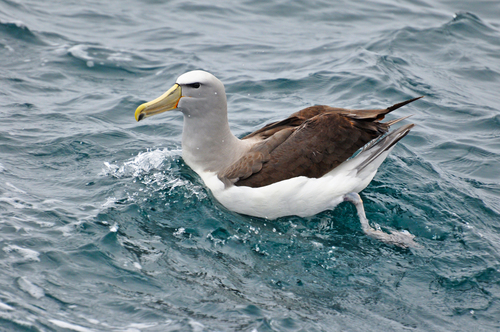
Salvin's Albatross
Thalassarche salvini
A master of the Southern Ocean, Salvin's Albatross is a magnificent glider known for its smoky-grey plumage and incredible long-distance migrations between New Zealand and South America.
Quick Identification
Size
Length: 90 cm (35 in); Wingspan: 2.5 m (8.2 ft); Weight: 3.3–4.9 kg (7.3–10.8 lb)
Colors
Grey cowl over head and throat, white underparts, dark grey upper wings and back, and a grey-green bill with yellow highlights.
Key Features
- Pale grey head and throat contrasting with white belly
- Yellowish-grey bill with a distinct black spot at the tip of the lower mandible
- Narrow dark borders on the white underwing
- Large, powerful wings built for dynamic soaring
When You’ll See Them
Geographic range
Where Does the Salvin's Albatross Live?
Salvin's Albatross is a nomadic traveler of the Southern Hemisphere, with its heart in the waters of Oceania. The species breeds almost exclusively on the Bounty Islands and Snares Islands of New Zealand, with a tiny secondary population found on the Crozet Islands in the Indian Ocean. Outside of the breeding season, they migrate across the vast Southern Ocean, reaching the nutrient-rich Humboldt Current along the coasts of Chile and Peru in South America, and occasionally venturing near the southern shores of Africa and Australia.
Basemap © OpenStreetMap contributors
Behavior
Salvin's Albatrosses are quintessential pelagic voyagers, spending the vast majority of their lives far out at sea. They are masters of dynamic soaring, a specialized flight technique that utilizes the wind gradients above waves to travel thousands of miles with almost no wing flapping. While they are generally solitary when traveling across the open ocean, they become highly social around food sources, often forming large, vocal groups known as 'rafts' when nutrient-rich currents or fishing vessels provide an abundance of prey.
During the breeding season, they congregate in massive colonies on rocky, wind-swept islands. These colonies are characterized by intense social activity, including ritualized displays, bill-clapping, and mutual preening to reinforce pair bonds. Unlike many other seabirds, Salvin's Albatrosses can be quite bold around humans, frequently following fishing boats for miles to scavenge for offal, a behavior that unfortunately makes them vulnerable to accidental capture in fishing gear.
EverydayEarth exclusive
Camera Tips
Capturing a Salvin's Albatross on a trail camera is a unique challenge because they are almost never found inland. If you live in a coastal area of New Zealand or along the South American coast, your best chance is to mount cameras on high coastal bluffs or headlands that overlook the ocean. Use a sturdy tripod or a permanent mount to withstand high winds, and angle the camera toward areas where updrafts are common, as these birds use those air currents to glide close to the shore.
Because albatrosses move at high speeds, you must use a camera with an extremely fast trigger speed—ideally under 0.3 seconds. Set your camera to 'Burst Mode' to take 3-5 photos per trigger; this increases the likelihood of getting a clear shot of the bird's face or the diagnostic underwing patterns. If you are using a camera on a boat or pier, consider a waterproof action camera with a high frame rate (60fps or higher) to capture the fluid motion of their flight, which can then be slowed down for analysis.
Lighting in marine environments can be tricky due to the high contrast between the dark sea and white plumage. To avoid 'blown-out' whites, set your camera's exposure compensation to -1.0 if the software allows it. The best time for filming is during the 'golden hours' of dawn and dusk when the sun is low; this provides a side-light that highlights the subtle grey 'cowl' on the Salvin's head. Avoid using flash at night, as it can be disorienting for birds navigating over water; instead, rely on high-quality sensors that perform well in low natural light.
Similar Species
Species that look similar or are commonly confused with Salvin's Albatross.
Frequently Asked Questions
Record Salvin's Albatross at your habitat
Connect a camera to start building your own species record — AI identifies every visitor automatically.