Shy Albatross
Thalassarche cauta
Meet Australia's only endemic albatross, a majestic sea-wanderer that spends its life gliding over the Southern Ocean. With its distinctive 'focused' expression and massive 2.5-meter wingspan, this endangered beauty is a breathtaking sight for coastal observers.
Quick Identification
Size
Length: 90-100 cm (35-39 in); Wingspan: 2.1-2.6 m (6.9-8.5 ft); Weight: 3.2-5.1 kg (7-11 lb)
Colors
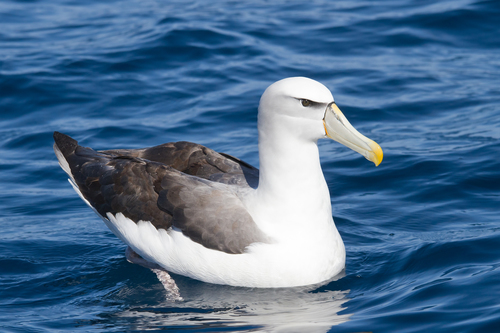
White body and neck with dark grey-black upper wings; white underwings with narrow black margins; distinctive grey-white face with a dark 'brow' smudge; pale bill with a yellow tip.
Key Features
- Small black 'thumbprint' mark at the base of the leading edge of the underwing
- Bold dark eyebrow smudge over a pale grey face
- Large, pale-grey bill with a prominent yellow tip
- Narrow black borders on the underside of the wings
When You’ll See Them
Geographic range
Where Does the Shy Albatross Live?
Native to the Southern Hemisphere, the Shy Albatross is uniquely Australian, being the only albatross species that breeds exclusively on three remote islands off the coast of Tasmania: Albatross Island, the Mewstone, and Pedra Branca. While these rocky outcrops serve as their core home, these magnificent gliders traverse the vast Southern Ocean, regularly patrolling the waters off South Africa and New Zealand. Occasionally, wandering individuals are recorded as far north as the Pacific coast of the United States, showcasing their incredible trans-oceanic reach.
Basemap © OpenStreetMap contributors
Behavior
The Shy Albatross is a master of the air, utilizing a flight technique called dynamic soaring to travel thousands of miles with minimal energy. Despite their name, they are not particularly timid around vessels; the name actually stems from their tendency to abandon nests if disturbed by human presence on their breeding islands. They are colonial nesters, congregating on rugged, wind-swept rocky outcrops where they perform elaborate courtship rituals involving synchronized bill-clacking and head-bobbing.
Most of their 60-year lifespan is spent at sea. They are opportunistic foragers, often seen following fishing trawlers to scavenge for discards. While they are solitary hunters on the open ocean, they can gather in large 'rafts' on the water's surface near breeding colonies or where food is abundant. They are surface-feeders but are capable of performing shallow dives to catch prey just beneath the waves.
EverydayEarth exclusive
Camera Tips
Capturing a Shy Albatross on an AI camera requires a coastal or marine setup, as these birds are strictly pelagic and will not visit a typical inland backyard. If you live on a coastal headland or cliffside, position your camera facing the windward side of the shore. These birds rely on updrafts to stay aloft, so they are most likely to glide close to land when strong onshore winds are blowing. Use a high-angle mount to look down toward the ocean surface or across the horizon where they are most active.
For the best results, set your camera to a high shutter speed—at least 1/2000s if possible—to freeze the bird's rapid motion against the bright sky or reflective sea. AI-powered cameras should be calibrated to recognize large, high-contrast shapes. Because of the intense glare common in marine environments, a polarizing filter is highly recommended to help the AI distinguish the bird's white plumage from the whitecaps of the waves. Late afternoon light is ideal, as it highlights the subtle grey tones of the face and the yellow tip of the bill.
If you are using a camera near a harbor or on a vessel, ensure the mount is vibration-resistant. Focus your 'detection zones' on the area just above the horizon where these birds often cruise. While they are attracted to fishing activity, never use bait to lure them, as this can encourage dangerous behavior near human structures. Instead, look for natural 'chokepoints' like narrow channels or known upwelling zones where the birds naturally congregate to feed.
Similar Species
Species that look similar or are commonly confused with Shy Albatross.
Frequently Asked Questions
Record Shy Albatross at your habitat
Connect a camera to start building your own species record — AI identifies every visitor automatically.