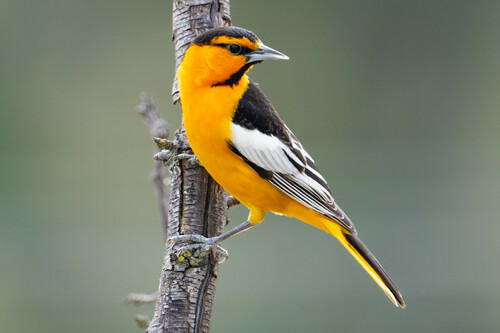
Bullock's Oriole
Icterus bullockii
The crown jewel of the Western canopy, the Bullock's Oriole dazzles with its fiery orange plumage and masterfully woven hanging nests. These acrobatic songbirds bring a touch of the tropics to North American backyards every spring.
Quick Identification
Size
Length: 17–19 cm (6.7–7.5 in); Wingspan: 31 cm (12.2 in); Weight: 29–43 g (1.0–1.5 oz)
Colors
Adult males feature vibrant orange underparts and faces with a black crown, throat patch, and a distinct black line through the eye. Females and juveniles are olive-gray on the back with a yellowish-orange head and tail.
Key Features
- Bright orange face with a thin black 'eyeline' stripe
- Large white wing patches visible even when perched
- Pointed, silver-gray beak for probing nectar
- Intricate hanging nests woven from plant fibers
When You’ll See Them
Sightings on EverydayEarth
May 31, 2026
A busy scene at the bird sanctuary viewing area. A White-winged Dove and a small Inca Dove are initially present on the feeders. A Mexican Jay soon flies in from the left, briefly displacing the other birds, while a female or immature Bullock's Oriole lands on the right platform to feed.
May 27, 2026
The feeding station is very busy with several Mexican Jays landing on the tube feeder, platform, and ground to scavenge for seeds. A White-winged Dove perches calmly on the top wooden crossbar, showing its distinctive white wing markings. A male Bullock's Oriole briefly lands in the background on the right side to investigate the ground area.
Geographic range
Where Does the Bullock's Oriole Live?
Native to the western half of North America, the Bullock's Oriole is primarily found across the Western United States and Southwestern Canada during the summer months. As the seasons turn, they migrate south to spend their winters in Mexico and parts of northern Central America. They are the western ecological counterpart to the Baltimore Oriole, with their range meeting and occasionally overlapping in the Great Plains.
Basemap © OpenStreetMap contributors
Behavior
Bullock's Orioles are incredibly agile foragers, often seen hanging upside down from the outer branches of trees to reach hidden insects or clusters of berries. They are known for their distinctive 'gaping' technique, where they insert their closed bill into a fruit or flower and then pry it open to access the juices inside. Their song is a rhythmic series of whistles, chatters, and harsh scolding notes that often rings out from the high canopy of cottonwood or sycamore trees.
These birds are highly migratory, traveling long distances between their breeding grounds in the Western United States and their wintering homes in Mexico. During the breeding season, they are somewhat solitary and territorial, but they can be lured into backyards with the right incentives. Their most remarkable social behavior is the construction of their nests; the female weaves a pendulous, sock-like pouch from hair, twine, and grass, usually suspended from the very tip of a flexible branch to deter predators.
EverydayEarth exclusive
Camera Tips
Capturing the vibrant orange of a Bullock's Oriole requires careful camera placement, as these birds spend much of their time high in the tree canopy. To bring them down to camera level, focus your setup on a specialized oriole feeder. These birds are famously attracted to the color orange; placing a feeder with bright orange accents or mounting a camera near a platform with halved oranges and small dishes of grape jelly is the most effective strategy. Aim your camera at the feeding station from a distance of 3 to 5 feet to ensure the AI can trigger accurately on the bird's rapid movements.
Lighting is critical for this species because their black and orange plumage can create high contrast. Avoid placing your camera where it will face the direct midday sun, which can blow out the orange tones. Instead, position your camera facing North or South to catch the soft, golden light of the early morning or late afternoon. This is also when the birds are most active, seeking out sugar-rich nectar to fuel their high-energy lifestyle. If your camera supports it, use a high frame rate or 'burst mode' to capture the moment they hover or spread their wings, revealing their large white wing patches.
Beyond food, Bullock's Orioles are strongly attracted to the sound of moving water. A birdbath with a solar-powered fountain or a simple 'dripper' can be a magnet for them. Position your camera at a low angle near the water's edge to capture unique bathing shots. In May and June, you can also look for their hanging nests in tall trees like cottonwoods or sycamores. While you should never disturb a nest, placing a camera on a nearby branch or using a telephoto lens from a distance can provide a fascinating window into their life as they bring food to their chicks.
Similar Species
Species that look similar or are commonly confused with Bullock's Oriole.
Baltimore Oriole
The Baltimore Oriole has a completely black head and throat, lacking the orange cheeks and black eyeline of the Bullock's.
Hooded Oriole
Hooded Orioles are more slender with a longer, more curved beak and have a much brighter, more yellowish-orange 'hood' that covers the back of the head.
Scott's Oriole
Scott's Orioles are bright lemon-yellow rather than orange, with a solid black hood and back.
Frequently Asked Questions
Record Bullock's Oriole at your habitat
Connect a camera to start building your own species record — AI identifies every visitor automatically.