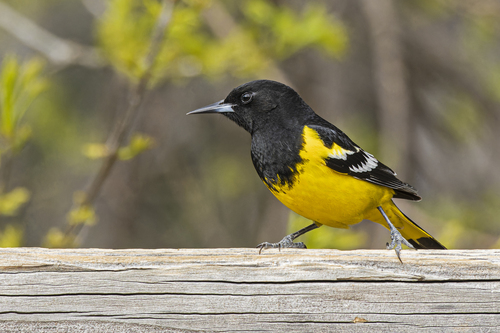
Scott's Oriole
Icterus parisorum
A striking flash of lemon-yellow against the desert sky, the Scott's Oriole is the master of the arid Southwest. Often found nesting in the heart of Yucca plants, these flutelike singers are a prized sight for any backyard observer.
Quick Identification
Size
Length: 7.9-9.1 in (20-23 cm); Wingspan: 11.4-12.6 in (29-32 cm); Weight: 1.1-1.5 oz (32-41 g)
Colors
Adult males are striking lemon-yellow and jet-black. Females are olive-green above and duller yellow below with subtle white wing bars.
Key Features
- Solid jet-black hood, back, and throat on males
- Bright lemon-yellow underparts and rump
- Long, sharply pointed, slightly decurved bill
- White wing bars on dark wings
When You’ll See Them
Behavior
These birds are highly energetic and acrobatic foragers. It is common to see them hanging upside down to reach the nectar at the base of a flower or hopping through desert scrub in search of insects. While they can be somewhat shy around human activity, they are very territorial during the breeding season and will vigorously defend their nesting sites from other birds. They are often first detected by their voice before they are seen, as their yellow plumage blends surprisingly well with the dappled light of desert woodlands.
EverydayEarth exclusive
Camera Tips
To capture the Scott's Oriole on camera, your setup should prioritize their unique relationship with desert flora. If you have Yucca, Agave, or Ocotillo on your property, place your camera roughly 5 to 7 feet off the ground, angled toward the blooming stalks. These birds are highly attracted to the nectar and the insects that congregate around these flowers. Because they prefer higher vantage points, avoid placing cameras too close to the ground; an elevated position on a fence post or a sturdy branch will yield much better results.
Using targeted lures is the most effective way to bring a Scott's Oriole into your camera’s frame. They are suckers for orange halves—simply nail an orange half to a post or tree within the camera's field of view. Specialized oriole nectar feeders filled with a 4:1 water-to-sugar ratio also work wonders. To get the best 'action' shots, place the feeder in a sunny spot that isn't obstructed by heavy foliage, which allows your AI camera to maintain a fast shutter speed to freeze the bird's movement without blur. Since these birds are early risers, ensure your camera’s low-light sensitivity is optimized for the dawn hour.
For the most compelling footage, use a 'Video' or 'Photo Burst' mode. Scott’s Orioles are 'probers'—they spend a lot of time sticking their bills into things—and a video will capture this fascinating behavior much better than a single still. During the peak of summer (June and July), water is a massive draw. A bird bath with a 'dripper' or 'mister' feature is an absolute magnet for Scott's Orioles. Setting your camera near a water source during the hottest part of the afternoon is a surefire way to capture them when they come down from the canopy to cool off.
Similar Species
Species that look similar or are commonly confused with Scott's Oriole.
Audubon's Oriole
Features a yellow back instead of a black one and is primarily restricted to South Texas.
Hooded Oriole
Has a more orange hue, a smaller black throat patch, and a much longer tail.
Orchard Oriole
Much smaller in size, and the adult male is a deep, dark chestnut color rather than bright yellow.
Frequently Asked Questions
Record Scott's Oriole at your habitat
Connect a camera to start building your own species record — AI identifies every visitor automatically.