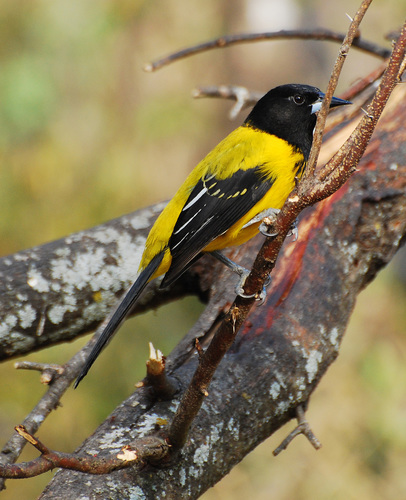
Audubon's Oriole
Icterus graduacauda
The Audubon's Oriole is a master of hide-and-seek, draped in brilliant yellow and a signature black hood. A year-round resident of the Texas-Mexico borderlands, it brings a touch of tropical mystery to any backyard lucky enough to host one.
Quick Identification
Size
Length: 7.5–9.4 in (19–24 cm); Wingspan: 12 in (31 cm); Weight: 1.1–1.9 oz (31–53 g)
Colors
Striking yellow body with an olive-green wash on the back; jet-black head, throat, and upper breast forming a 'hood'; black wings with white edging and a black tail. Males and females look nearly identical.
Key Features
- Solid black hood covering the entire head and bib
- Bright yellow to lemon-lime body plumage
- Black wings with narrow white wing bars
- Heavy, slightly curved bill with a blue-gray base
When You’ll See Them
Geographic range
Where Does the Audubon's Oriole Live?
Native to the North American subtropics, the Audubon's Oriole is found primarily along the eastern and western coasts of Mexico. Its northernmost reach extends into the United States specifically within the Lower Rio Grande Valley of southeastern Texas. This species is a permanent resident throughout its range, meaning it does not undertake the long-distance migrations typical of other oriole species.
Basemap © OpenStreetMap contributors
Behavior
Unlike many of its bolder oriole cousins, the Audubon's Oriole is a remarkably shy and retiring bird. It prefers to remain concealed within dense riverside thickets and thorn scrub, where it moves slowly through the canopy searching for food. Because of this elusive nature, they are often heard before they are seen; their song is a series of slow, melancholic, human-like whistles that sound almost as if a person is absent-mindedly whistling a tune.
These birds are non-migratory and form strong pair bonds, often staying together on their territory throughout the year. While they are generally solitary or found in pairs, they may occasionally join mixed-species foraging flocks during the winter months. In backyard settings, they are cautious visitors but can become regular guests if provided with enough cover and high-quality food sources like suet or nectar.
EverydayEarth exclusive
Camera Tips
To capture the elusive Audubon's Oriole on camera, location is everything. These birds rarely venture far from dense cover, so place your camera near the edge of thick brush or within a heavily landscaped backyard. A water feature is your best bet; they are highly attracted to the sound of dripping or moving water. Position your camera at eye level with a birdbath, roughly 3 to 5 feet away, ensuring the background is blurred to make the bird's bright yellow plumage pop.
While they forage for insects, they are also frequent visitors to specialized feeders. Unlike other orioles that prefer orange halves, Audubon's Orioles are particularly fond of high-quality suet (especially insect or fruit-filled varieties) and sunflower seeds. Setting up a suet cage near a known perching spot can provide consistent, high-quality shots. Because they are shy, use a camera with a fast trigger speed (0.3s or less) and consider a 'no-glow' infrared flash for nighttime activity, though they are strictly diurnal.
For the best lighting, aim for the golden hours of early morning. Their yellow feathers can easily 'blow out' and lose detail in harsh midday sun. If your camera allows for it, slightly underexpose the image to preserve the rich saturation of their yellow body and the deep textures of their black hood. If you are using a trail camera, setting it to 'Photo + Video' mode is ideal, as it allows you to capture their unique, slow-moving foraging behavior and their melodic whistling calls.
Similar Species
Species that look similar or are commonly confused with Audubon's Oriole.
Altamira Oriole
Larger and more orange than yellow; has a black mask and throat patch rather than a full black hood.
Hooded Oriole
The male has a black mask and bib, but the top of the head (the 'hood') is yellow or orange, whereas the Audubon's hood is entirely black.
Scott's Oriole
Found in more arid, desert habitats; has a black back and breast, while the Audubon's has a yellow/olive back.
Frequently Asked Questions
Record Audubon's Oriole at your habitat
Connect a camera to start building your own species record — AI identifies every visitor automatically.