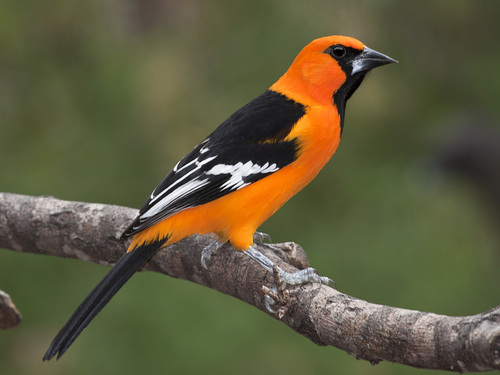
Altamira Oriole
Icterus gularis
The crown jewel of the Rio Grande Valley, the Altamira Oriole brings a burst of tropical orange to the borderlands. As North America's largest oriole, this resident beauty is famous for its massive hanging nests and its bold, whistled songs.
Quick Identification
Size
Length: 21–25 cm (8.3–9.8 in); Wingspan: 36 cm (14.2 in); Weight: 47–64 g (1.7–2.3 oz)
Colors
Brilliant orange body with black wings, tail, and throat. Males and females are similar, both featuring a distinctive orange patch on the shoulder (lesser coverts).
Key Features
- Large, thick-based black bill
- Solid black bib extending from chin to upper breast
- Orange shoulder patch on black wings
- Long, graduated black tail
When You’ll See Them
Geographic range
Where Does the Altamira Oriole Live?
Native to the North American continent, the Altamira Oriole is a characteristic species of the subtropical lowlands and coastal plains. Its core range spans from the Rio Grande Valley in southernmost Texas through the eastern and southern regions of Mexico, extending into northern Central America through Guatemala and Belize. As a non-migratory resident, it remains in these warm, lowland environments throughout the year, marking the northernmost edge of its tropical lineage in the United States.
Basemap © OpenStreetMap contributors
Behavior
One of their most fascinating behaviors is their architectural prowess. They weave incredible pendulous nests that can reach over two feet in length. These nests are often suspended from the very tips of branches, frequently overhanging roads, trails, or water to make it difficult for climbing predators to reach the eggs. In backyard settings, they are curious but cautious, often the dominant bird at nectar or fruit feeders due to their large size.
EverydayEarth exclusive
Camera Tips
Since Altamira Orioles are larger than most other backyard birds, ensure your feeder or perching station is sturdy. They have a tendency to hang upside down while feeding, so a camera angle that captures the underside of branches or the side of a feeder will often result in more dynamic action shots. Lighting is crucial for these birds; their orange plumage is exceptionally vibrant. Try to position your camera so the morning sun (eastward facing) hits the bird's side, which will make the orange 'pop' without washing out the black details of the face and wings.
If you are lucky enough to have them nesting nearby, look for their long, hanging nests in tall trees like ash or pecan. Avoid placing cameras too close to the nest to prevent disturbance, but setting up a camera on a tripod with a view of a nearby 'staging' branch where the parents land before entering the nest can provide incredible footage of them carrying insects or fruit to their young. For camera settings, use a fast trigger speed and a high-resolution video mode, as their visits can be brief but full of interesting vocalizations and social interactions.
Similar Species
Species that look similar or are commonly confused with Altamira Oriole.
Audubon's Oriole
Has a solid black head (hood) rather than just a black bib and mask, and lacks the orange shoulder patch.
Hooded Oriole
Smaller and more slender with a thinner, down-curved bill and white wing bars instead of an orange shoulder patch.
Bullock's Oriole
Males have a large white wing patch and a black line through the eye, rather than the solid black mask and bib of the Altamira.
Frequently Asked Questions
Record Altamira Oriole at your habitat
Connect a camera to start building your own species record — AI identifies every visitor automatically.