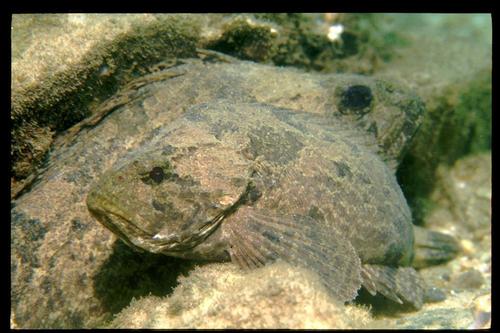
Bullrout
Notesthes robusta
The ultimate master of disguise in Australian waterways, the Bullrout is a venomous ambush predator that perfectly mimics the river bottom. Often called the freshwater stonefish, it is a fascinating subject for those willing to peek beneath the surface of coastal creeks.
Quick Identification
Size
Typically 15-25 cm (6-10 inches) long, reaching a maximum of 30 cm (12 inches); weight up to 1 kg (2.2 lbs)
Colors
Mottled pattern of pale yellow, dark brown, grey, and black; colors shift to match the surrounding substrate
Key Features
- Large, bony head with distinct ridges
- 15 sharp, venomous dorsal spines
- Camouflaged, scale-less appearance resembling a rock
- Large, fan-like pectoral fins
When You’ll See Them
Geographic range
Where Does the Bullrout Live?
Native to the eastern coast of Australia, the Bullrout occupies a narrow but long strip of territory. It is commonly found from the Shoalhaven River in southern New South Wales up through the tropical river systems of northern Queensland. This species thrives in the transition zones between salt and fresh water, often moving quite far upstream into purely freshwater environments as long as there is sufficient cover and slow-moving current.
Basemap © OpenStreetMap contributors
Behavior
The Bullrout is a master of camouflage and a patient ambush predator. It spends the majority of its time motionless on the bottom of riverbeds or estuaries, blending perfectly with rocks, mud, and leaf litter. While it may appear sluggish, it is capable of lightning-fast lunges when a small fish or crustacean wanders within range of its large mouth. It is primarily a solitary species, staking out a preferred territory near submerged cover.
Interactions with humans are usually accidental and can be painful. Because they rely on camouflage rather than flight, they often stay put when someone wades nearby. If stepped on, the Bullrout's dorsal spines inject a potent venom that causes intense, long-lasting pain. Despite this defensive capability, they are not aggressive and will not seek out humans; they simply hold their ground in the shadows of the creek bed.
EverydayEarth exclusive
Camera Tips
To capture a Bullrout on camera, you must go sub-surface. Use a waterproof action camera or a specialized underwater trail camera with high-quality infrared (IR) night vision. Because Bullrouts are masters of blending in, your camera needs to be positioned very low, almost resting on the substrate. Focus your lens on a 'choke point' in the creek—such as a small gap between two rocks or the area immediately in front of a submerged log where the fish is likely to shelter.
Baiting is highly effective for this species. Place a weighted mesh bag filled with crushed prawns or fish scraps roughly 30–50 cm (12-20 inches) in front of the lens. The scent won't just attract the Bullrout; it will draw in small shrimp and baitfish. This creates a 'hunting stage' where you are likely to record the Bullrout moving into the frame to capitalize on the concentrated prey. Use video mode rather than stills, as the Bullrout’s movement is subtle and its strike is too fast for most photo triggers.
Lighting is your biggest challenge. In murky estuary water, standard white light flashes will cause 'backscatter' (reflecting off particles in the water). Use 'no-glow' or 940nm IR settings to avoid spooking the fish and to reduce glare. If possible, set the camera to record 30-second clips to capture the slow, stalking movements they use when approaching prey. Always ensure your camera is securely tethered to a fixed object on the bank to prevent losing your gear during a sudden rise in water level or flash flood.
Similar Species
Species that look similar or are commonly confused with Bullrout.
Frequently Asked Questions
Record Bullrout at your habitat
Connect a camera to start building your own species record — AI identifies every visitor automatically.