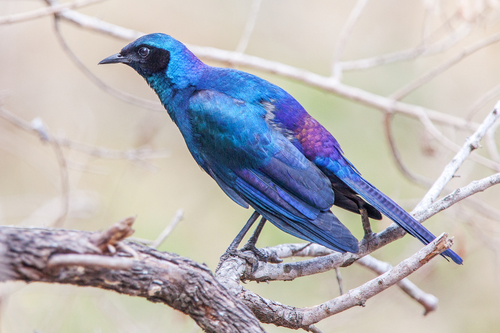
Burchell's Starling
Lamprotornis australis
With its shimmering emerald plumage and heavy-set silhouette, the Burchell's Starling is a gem of the southern African savanna. A frequent visitor to backyards and campsites, this social bird brings a touch of iridescent elegance to any camera feed.
Quick Identification
Size
30-34 cm (12-13.5 inches) in length; weighs between 100-140 g (3.5-4.9 oz)
Colors
Deep iridescent dark green and blue-black plumage throughout; plumage shows purple reflections in certain light. Iris is dark brown to black; bill and legs are black.
Key Features
- Large, heavy-set body compared to other starlings
- Dark eyes (no yellow or red iris)
- Uniformly glossy greenish-blue plumage
- Squared-off or slightly rounded broad tail
When You’ll See Them
Geographic range
Where Does the Burchell's Starling Live?
The Burchell's Starling is a classic resident of the southern African interior. This bird thrives across a core range that includes the vast savannas of Botswana and Namibia, extending into the northern provinces of South Africa, western Zimbabwe, and southern Angola. Because they prefer dry to mesic woodlands, they are most common in areas where large trees provide nesting cavities and the ground is open enough for their characteristic terrestrial foraging.
Basemap © OpenStreetMap contributors
Behavior
Burchell’s Starlings are social and gregarious birds, often seen in pairs or small family groups. They are primarily terrestrial foragers, spending much of their day walking or hopping along the ground with a deliberate, heavy gait. Unlike many of their more flighty relatives, they appear quite bold and confident, particularly around human settlements, campsites, and farmsteads where they scavenge for food scraps.
These starlings are monogamous and remain resident in their territory year-round. They are cooperative breeders at times, with family members helping to raise the young. While they can be vocal, their calls are often described as a mix of raspy clucks, squeaks, and melodic warbles, usually less piercing than the calls of the smaller glossy starling species.
EverydayEarth exclusive
Camera Tips
To get the best shots of Burchell’s Starling, you need to account for their terrestrial habits. Place your camera at a low height—roughly 30 to 60 centimeters (1 to 2 feet) off the ground—facing a clear patch of dirt or short grass. These birds are heavy foragers and will often spend several minutes in one spot if there is something to investigate. Because their feathers are highly iridescent, positioning the camera so the sun is behind it (facing South in the Southern Hemisphere) will ensure the light hits the feathers directly, revealing the brilliant greens and blues that otherwise look black in the shade.
A shallow birdbath is an incredible magnet for this species. They are enthusiastic bathers and frequent drinkers, especially in the arid regions they call home. Setting your camera near a water source with a fast trigger speed or 'Burst Mode' will help you catch the spectacular water splashes and the fanning of their iridescent wings. If you are using a trail camera with adjustable settings, a high-sensitivity PIR (motion sensor) setting is recommended as their walking movement is steadier and less erratic than smaller songbirds.
Feeding stations can also yield great results. They are particularly fond of suet, chopped fruits like apples or grapes, and mealworms. Because they are social birds, you will often find three or four individuals competing for food, which provides excellent opportunities for capturing social interactions. During the breeding season (October to March), look for them carrying nesting material; placing a camera near a known tree cavity can capture unique nesting behaviors.
Similar Species
Species that look similar or are commonly confused with Burchell's Starling.
Frequently Asked Questions
Record Burchell's Starling at your habitat
Connect a camera to start building your own species record — AI identifies every visitor automatically.