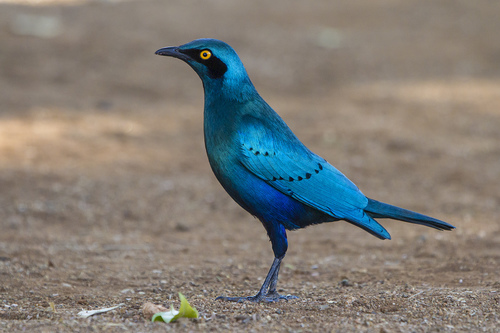
Greater Blue-eared Starling
Lamprotornis chalybaeus
A masterpiece of iridescent color, the Greater Blue-eared Starling is a social African icon. Its shimmering metallic feathers and piercing yellow eyes make it a favorite for backyard birders and wildlife photographers alike.
Quick Identification
Size
Length of 22–24 cm (8.5–9.5 in); Wingspan approx. 38–42 cm (15–16.5 in); Weight 75–105g (2.6–3.7 oz)
Colors
Adults are overall metallic blue-green with a violet-blue belly and flanks. They feature a distinctive dark blue-black ear patch and bright yellow or orange irises. Sexes are similar in appearance.
Key Features
- Brilliant iridescent blue-green plumage
- Prominent dark blue ear-coverts
- Striking bright yellow to orange-red iris
- Short, square-ended tail
- Large, robust black bill
When You’ll See Them
Sightings on EverydayEarth
Jun 12, 2026
A common hippopotamus rests in the center of the waterhole, mostly submerged with its ears and snout visible. A blacksmith lapwing is foraging on the grassy bank to the left. At the end of the footage, a greater blue-eared starling flies across the scene from right to left.
Apr 11, 2026
A vibrant Greater Blue-eared Starling perches prominently on a branch, its iridescent feathers catching the light as it looks around. Nearby, a Red-billed Buffalo Weaver hops between branches in the same tree, momentarily coming into clear view before moving further into the foliage.
Apr 2, 2026
A Common Hippopotamus stands on a high bank at the edge of dense green bushes. The large mammal remains relatively still, occasionally lowering its head to sniff or graze at the ground. Several bright blue starlings hop around the hippo, likely foraging for insects in the disturbed soil near the animal's feet.
Geographic range
Where Does the Greater Blue-eared Starling Live?
Native to the vast sub-Saharan African continent, the Greater Blue-eared Starling occupies a massive range from Senegal and the Gambia in the west, stretching eastwards to Ethiopia and Eritrea. Its territory extends southward through East Africa into northeastern South Africa, Botswana, and Angola, making it one of the most widely distributed glossy starlings in the region.
Basemap © OpenStreetMap contributors
Recorded on EverydayEarth
Behavior
The Greater Blue-eared Starling is a highly gregarious bird, known for forming large, noisy flocks outside of the breeding season. These birds are extremely vocal, possessing a wide repertoire of whistles, warbles, and mimicry that can often be heard before the bird is even seen. They are well-adapted to human environments, frequently visiting suburban gardens and campsites where they may become quite bold in search of food scraps.
In the wild, they exhibit a fascinating symbiotic relationship with large mammals. You will often see them perched on the backs of cattle, zebras, or antelopes, where they forage for ectoparasites. On the ground, they move with a characteristic hopping gait, actively searching for insects and fallen fruit. During the breeding season, they are cavity nesters, often utilizing old woodpecker or barbet holes in trees.
EverydayEarth exclusive
Camera Tips
To capture the stunning iridescence of the Greater Blue-eared Starling, camera placement is everything. These birds are frequent visitors to water sources, so positioning your camera near a bird bath or a shallow garden pond is your best bet. Set the camera at a low angle, roughly 1 to 2 feet off the ground, to capture their characteristic ground-foraging hops and reflections in the water.
Lighting is the 'secret sauce' for this species. Because their feathers rely on light refraction to show color, aim your camera with the sun at its back (facing away from the sun). The 'golden hour' shortly after sunrise or before sunset will produce the most dramatic metallic blues and greens. If the light is too flat or the bird is in deep shade, they can unfortunately appear almost black on camera.
For baiting, these starlings are easily attracted to suet, mealworms, or halved fruits like papaya and oranges placed on a platform feeder. Use a fast shutter speed (at least 1/1000s if your camera allows manual overrides) because they are twitchy, fast-moving birds. Since they often travel in groups, use a wider focal length to capture the social dynamics of the flock rather than just a single individual.
Similar Species
Species that look similar or are commonly confused with Greater Blue-eared Starling.
Frequently Asked Questions
Record Greater Blue-eared Starling at your habitat
Connect a camera to start building your own species record — AI identifies every visitor automatically.