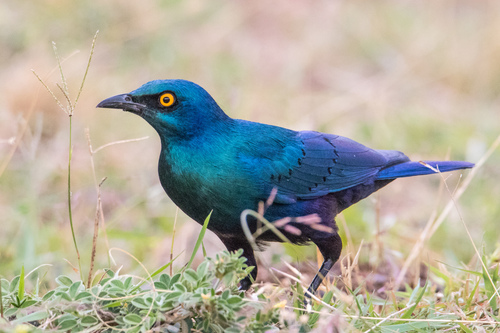
Lesser Blue-eared Starling
Lamprotornis chloropterus
A shimmer of living metal in the African savanna, the Lesser Blue-eared Starling dazzles with its iridescent plumage and piercing golden eyes. A social and intelligent visitor, it brings a spark of brilliant color to woodlands and gardens alike.
Quick Identification
Size
18–20 cm (7–8 inches) in length; weight ranges from 50–78 g (1.8–2.7 oz)
Colors
Glossy blue-green metallic plumage with violet-blue ear patches; bright yellow or golden-orange eyes; blackish bill and legs
Key Features
- Metallic blue-green iridescence
- Bright yellow-orange iris
- Small purple ear patch
- Relatively short, square-ended tail
- Magenta-purple patch on the flanks
When You’ll See Them
Geographic range
Where Does the Lesser Blue-eared Starling Live?
The Lesser Blue-eared Starling is native to the African continent, occupying a vast latitudinal belt across sub-Saharan Africa. Its range extends from the Atlantic coast in Senegal and Gambia, eastward through the Sahel and Savannah regions to Ethiopia and Eritrea, and southward into Kenya, Zambia, and Mozambique. While they are largely resident throughout their range, some northern populations are known to be intra-African migrants, moving south during the dry season.
Basemap © OpenStreetMap contributors
Behavior
The Lesser Blue-eared Starling is a highly social bird, typically found in small flocks during the day and congregating in much larger communal roosts at night. They are energetic and vocal, known for a complex repertoire of whistles, warbles, and occasionally mimicry of other birds. In a backyard setting, they are confident and active, often being the first to investigate a new water source or feeder.
These starlings spend a significant amount of time foraging on the ground, walking with a brisk, upright gait rather than hopping. They are also known to follow large mammals or even lawnmowers to catch insects flushed from the grass. While they are generally peaceful toward other species, they can be quite competitive with one another during the breeding season when defending nesting cavities in trees.
EverydayEarth exclusive
Camera Tips
To capture the breathtaking metallic sheen of the Lesser Blue-eared Starling, camera placement is everything. The iridescent feathers look dull in deep shade but can 'blow out' in direct midday sun. For the best results, position your camera to face North or South so the low morning or late afternoon sun hits the birds at a side-angle. This brings out the deep purples and greens that make this species so special.
These birds are particularly drawn to water. A birdbath or a shallow basin placed 3-5 feet away from your camera lens will yield fantastic 'action' shots. If you are using an AI-powered camera like a Bird Buddy or a similar backyard setup, try placing halved oranges or suet blocks near the camera. The starlings are bold and will quickly learn the location of a reliable food source, often visiting in pairs or small groups.
Set your camera to a fast shutter speed or 'Sports Mode' if available, as these birds are twitchy and fast-moving. Because they often forage on the ground, a secondary camera placed low to the earth near a cleared patch of grass or a leaf litter pile can capture unique low-angle perspectives of their confident walking gait and striking golden eyes. Avoid placing the camera too high; a height of 3 to 4 feet is the 'sweet spot' for eye-level portraits.
Similar Species
Species that look similar or are commonly confused with Lesser Blue-eared Starling.
Frequently Asked Questions
Record Lesser Blue-eared Starling at your habitat
Connect a camera to start building your own species record — AI identifies every visitor automatically.