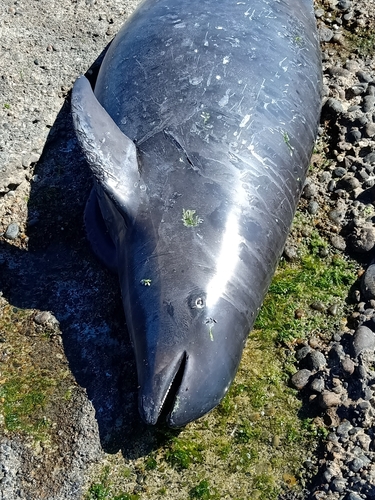
Burmeister's Porpoise
Phocoena spinipinnis
The 'black porpoise' of South America is a master of stealth, gliding through shallow coastal waters with a unique, backward-set dorsal fin. Elusive and shy, this small cetacean offers a rare glimpse into the quiet side of marine life.
Quick Identification
Size
1.4 to 2.0 meters (4.6 to 6.6 feet) in length; weighs 40 to 85 kg (88 to 187 lbs)
Colors
Dark charcoal to nearly black dorsal side; lighter grey or white belly; dark grey flippers
Key Features
- Dorsal fin set significantly far back on the body
- Distinctive tubercles (small bumps) on the leading edge of the dorsal fin
- Blunt, rounded head without a protruding beak
- Small, spade-shaped teeth
When You’ll See Them
Geographic range
Where Does the Burmeister's Porpoise Live?
Native to the coastal waters of South America, Burmeister's Porpoise inhabits a nearly continuous range from the Pacific coast of northern Peru, down around the southern tip of Cape Horn, and up the Atlantic coast to southern Brazil. They are most frequently encountered in the cool, nutrient-rich zones of the Humboldt Current in the west and the Falkland Current in the east. This species is a dedicated coastal resident, rarely venturing into the deep oceanic waters beyond the continental shelf.
Basemap © OpenStreetMap contributors
Behavior
Burmeister’s porpoises are famously shy and elusive marine mammals, often referred to as 'breath-and-gone' animals due to their extremely low-profile surfacing style. Unlike more gregarious dolphins, they rarely leap from the water or ride the bow waves of boats. Instead, they rise quietly to the surface with a gentle roll, making them very difficult to spot even in relatively calm conditions. They are typically found in small pods of one to six individuals, though larger groups may occasionally gather in areas with abundant food.
These porpoises are coastal specialists, spending most of their time in shallow waters, estuaries, and bays. They are highly sensitive to underwater noise and tend to move away from motorized vessels, which has made them one of the least-studied cetaceans in South American waters. Their social lives remain largely a mystery, but they are known to be non-aggressive foragers that rely on stealth rather than speed to navigate their environment.
EverydayEarth exclusive
Camera Tips
Capturing Burmeister's Porpoise on camera is a unique challenge that requires a coastal-specific approach. If you have a property overlooking a calm bay or estuary, the best setup is a high-resolution, shore-based camera mounted on a tripod or pier. Because these porpoises have a very low profile when surfacing, use a telephoto lens or a camera with high optical zoom focused on the 'glassy' patches of water during high tide. Motion sensors often fail to trigger on their subtle movements, so set your camera to record time-lapse intervals or use continuous video during peak hours.
For those with direct water access, an underwater stationary camera (like an action camera in a waterproof housing) can be highly effective. Mount the camera 1-3 meters below the surface on a dock piling or a weighted buoy tether near kelp forest edges. Since Burmeister’s porpoises are wary of new objects, try to camouflage the housing with dark, non-reflective tape and leave it in place for several days to allow them to acclimate to its presence. Avoid using any lights or flash, as the sudden illumination will likely spook them.
The best time for photography is during the early morning hours when the wind is at its lowest and the sea surface is flat. High tide is particularly productive, as the porpoises follow schools of baitfish closer to the shore and into estuaries. While you cannot use bait to attract them, positioning your camera near natural features that trap fish—such as rock walls, piers, or dense kelp beds—will significantly increase your chances of a successful sighting.
Similar Species
Species that look similar or are commonly confused with Burmeister's Porpoise.
Frequently Asked Questions
Record Burmeister's Porpoise at your habitat
Connect a camera to start building your own species record — AI identifies every visitor automatically.