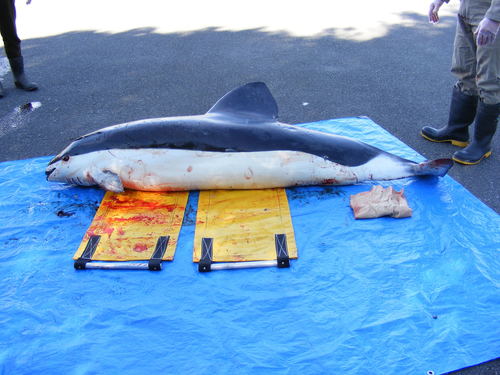
Spectacled Porpoise
Phocoena dioptrica
The ghost of the Southern Ocean, the Spectacled Porpoise is a striking black-and-white enigma. One of the rarest sights in the sea, its tuxedo-like appearance and shy nature make every sighting a major scientific event.
Quick Identification
Size
1.5 to 2.2 meters (4.9 to 7.2 feet) in length; 60 to 115 kg (132 to 253 lbs) in weight
Colors
Distinctly bicolored with a jet-black back and stark white belly; males have a black ring around their eyes and a larger, rounded dorsal fin.
Key Features
- Sharp horizontal line separating black upper body from white lower body
- Large, rounded dorsal fin (especially prominent in males)
- Characteristic black 'spectacle' rings around the eyes
- Pale gray stripe along the upper tail stock
When You’ll See Them
Behavior
The Spectacled Porpoise is a master of the deep, cold waters of the Southern Ocean. Unlike many of its dolphin relatives, this species is notoriously shy and rarely approaches vessels to bow-ride. Their swimming style is generally inconspicuous; they tend to surface with a gentle, slow roll that creates very little splash, making them incredibly difficult to spot in choppy waters. They are most often sighted alone or in very small mother-and-calf pairs, though occasional small groups have been recorded.
Relatively little is known about their social lives due to their remote habitat, but they appear to be fast, agile swimmers when necessary. They rely heavily on sophisticated echolocation to navigate the murky depths and communicate in the vastness of the sub-Antarctic. While they don't perform the acrobatic leaps seen in other cetaceans, their distinctive appearance makes them unmistakable to those lucky enough to witness a rare surfacing event.
EverydayEarth exclusive
Camera Tips
Capturing a Spectacled Porpoise on camera is one of the most challenging feats for a wildlife enthusiast. Because these are strictly marine animals, your 'backyard' needs to be a coastal cliff or a shoreline overlooking cold Southern Hemisphere waters. For land-based setups, place your camera at a high elevation to gain a better angle into the water and reduce the 'blind spot' caused by waves. A high-resolution trail camera with a telephoto lens or a high-powered digital zoom is essential, as these animals rarely come close to the shore. Set your camera to a high-speed burst mode (at least 3-5 photos per trigger) to ensure you catch the moment they break the surface.
If you are using an underwater rig or a waterproof camera housing near a pier or rocky outcrop, focus on areas where the current is known to concentrate baitfish. Since PIR motion sensors don't work through water or over long distances at sea, use a time-lapse setting instead. Set the interval to 1 or 2 seconds during the peak daylight hours of 10 AM to 3 PM when the sun is highest in the sky; this provides the best light penetration into the water and minimizes the surface glare that can wash out the porpoise's distinctive black-and-white markings.
For those living in Patagonia, the Falklands, or southern New Zealand, seasonal placement is key. Deploy your gear during the calmer summer months when surface visibility is highest. If you're mounting a camera on a stationary buoy or boat dock, ensure the mount is vibration-dampened; the subtle roll of a Spectacled Porpoise is easily missed if the camera is shaking in the wind. A circular polarizing filter is your best friend here, as it will cut through the reflection on the ocean surface, allowing your AI to better recognize the stark white-to-black transition of a surfacing porpoise.
Similar Species
Species that look similar or are commonly confused with Spectacled Porpoise.
Frequently Asked Questions
Record Spectacled Porpoise at your habitat
Connect a camera to start building your own species record — AI identifies every visitor automatically.