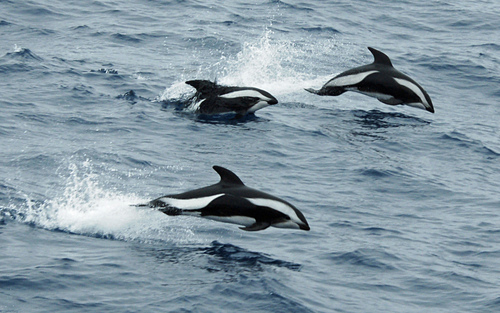
Hourglass Dolphin
Cephalorhynchus cruciger
The 'sea cow' of the Antarctic, the Hourglass Dolphin is a striking black-and-white acrobat that thrives in the world's most turbulent southern waters.
Quick Identification
Size
Length of 1.6 to 1.8 meters (5.2 to 5.9 feet); weight ranges from 90 to 120 kg (200 to 265 lbs)
Colors
High-contrast black and white; features a black back and white belly with distinctive white patches on the sides that narrow under the dorsal fin.
Key Features
- Striking black-and-white 'hourglass' markings on sides
- Tall, prominently curved (falcate) dorsal fin
- Short, stubby beak and stocky body build
When You’ll See Them
Geographic range
Where Does the Hourglass Dolphin Live?
The Hourglass Dolphin is a native of the Southern Ocean, living in a circumpolar band around the Antarctic continent. It is typically found between the latitudes of 45°S and 68°S, following the cold Antarctic Circumpolar Current. While they are most concentrated near the Antarctic Peninsula and the Drake Passage, they are also occasionally spotted in the deep waters off the coasts of southern Chile, Argentina, and New Zealand during the winter months.
Basemap © OpenStreetMap contributors
Behavior
Hourglass Dolphins are the energetic speedsters of the cold Southern Ocean. They are most famous among mariners for their 'porpoising' behavior—leaping out of the water at high speeds, which creates a characteristic 'rooster tail' spray of water. They are highly social but usually travel in small pods of 1 to 15 individuals, though they have been known to congregate in groups of up to 100 near nutrient-rich feeding grounds.
These dolphins are remarkably bold and are frequently seen bow-riding alongside fast-moving vessels or swimming in the pressure waves of large whales, particularly Fin whales. Because they live in the remote, turbulent waters of the Antarctic Convergence, they have had relatively little interaction with humans compared to coastal species, yet they remain one of the most inquisitive and approachable cetaceans in the region.
EverydayEarth exclusive
Camera Tips
Capturing the Hourglass Dolphin requires a departure from standard backyard camera setups, as this species is strictly oceanic. For the best results, cameras should be mounted on expedition vessels or research boats traveling through the Southern Ocean. Use a high-quality action camera or a specialized marine housing mounted as low to the water line as possible—ideally on the bow or the stern quarter—to capture their dramatic bow-riding and leaping behavior.
Because these dolphins move at incredible speeds, your camera settings are critical. Set a fast shutter speed of at least 1/2000 of a second to freeze the action and the spray of the 'rooster tail.' AI-powered cameras should be set to high-sensitivity motion triggers. Since the light in the Antarctic can be extremely harsh with heavy glare from the water, a circular polarizing filter is an absolute necessity to cut through reflections and reveal the dolphin's white markings beneath the surface.
During the Austral summer, you can take advantage of nearly 24-hour daylight in their southern range. Wide-angle lenses are generally better than telephotos for fixed cameras, as these dolphins move unpredictably and can be very close to the vessel hull. If you are using a camera with AI detection, ensure the firmware is updated to recognize marine mammals, or use a 'burst mode' trigger to ensure you don't miss the moment they breach the surface.
Similar Species
Species that look similar or are commonly confused with Hourglass Dolphin.
Frequently Asked Questions
Record Hourglass Dolphin at your habitat
Connect a camera to start building your own species record — AI identifies every visitor automatically.