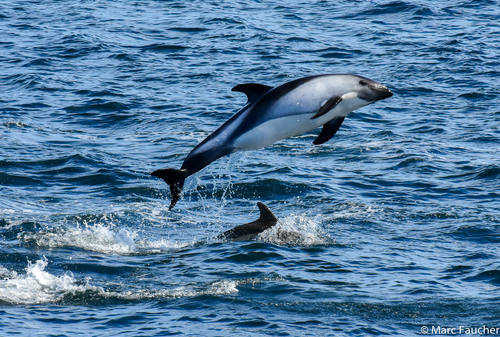
Peale's Dolphin
Cephalorhynchus australis
A playful sentinel of the Patagonian coast, Peale's Dolphin is a master of the kelp forests. With its striking monochromatic markings and acrobatic spirit, it turns the cold southern waters into a natural theater.
Quick Identification
Size
Length: 2–2.2 meters (6.6–7.2 feet); Weight: 115 kilograms (254 lbs)
Colors
Dark gray to black back and head, light gray curved flank patches, and a stark white belly and throat
Key Features
- Large, sickle-shaped dorsal fin with a curved trailing edge
- Light gray 'arm' or 'thigh' patch on the lower flanks
- Distinctive black face and chin separated from a white throat
When You’ll See Them
Behavior
Peale's Dolphins are among the most energetic and social cetaceans found in the cold coastal waters of South America. Known for their acrobatic displays, they are frequently observed leaping from the water and 'bow-riding'—hitching a ride on the pressure waves created by passing boats. Unlike many other dolphin species that prefer the open ocean, Peale's Dolphins are highly coastal, often spending their entire lives within a few kilometers of the shore, particularly around the rugged fjords and channels of the south.
These dolphins exhibit a unique affinity for kelp forests (Macrocystis pyrifera), using the dense underwater jungles for protection from predators like Orcas and as a primary hunting ground. They are typically found in small pods of 2 to 13 individuals, though larger aggregations may form during feeding frenzies. They are known to be quite curious and will often approach stationary observers on piers or rocky outcrops, making them a favorite for coastal wildlife watchers.
EverydayEarth exclusive
Camera Tips
Capturing Peale's Dolphins requires a specialized approach since they are marine mammals, but for those living along the rugged coastlines of southern South America, they are the ultimate 'backyard' challenge. The most effective setup involves mounting a weather-sealed trail camera or a high-end action camera with a deep-cycle battery on a stable coastal overlook, pier, or rocky outcropping. Because these dolphins frequent the 'kelp fringe,' aim your lens specifically at the edge of visible kelp forests where the water begins to deepen; this is where they most frequently forage and socialize.
Lighting is your biggest hurdle when filming over water. Use a camera with a high-quality lens or, if using a manual setup, add a circular polarizing (CPL) filter to eliminate surface glare. Without this, the sun's reflection off the waves will often blow out the image, making it impossible to see the dolphin's subtle gray markings. Set your shutter speed to at least 1/1000 of a second or use a 'Sports' mode to freeze the action of a breach or a fast bow-ride. If your camera supports it, the 'burst mode' or high-frame-rate video (60fps or higher) is essential for capturing the split-second moment their dorsal fin breaks the surface.
Since you cannot use traditional bait, your best 'lure' is timing and location. Peale's Dolphins are highly curious and often approach small boats or even stationary observers near the shore. If you are setting up a stationary trail camera, choose a point of land that juts into a channel where currents are strong, as they use these 'bottlenecks' to hunt. Peak visibility is usually mid-morning when the sun is high enough to penetrate the water but not yet creating a direct blinding reflection from the west. In terms of settings, keep your ISO as low as possible to maintain detail in the dolphin's white underbelly, which can easily become overexposed against the dark ocean water.
Similar Species
Species that look similar or are commonly confused with Peale's Dolphin.
Frequently Asked Questions
Record Peale's Dolphin at your habitat
Connect a camera to start building your own species record — AI identifies every visitor automatically.