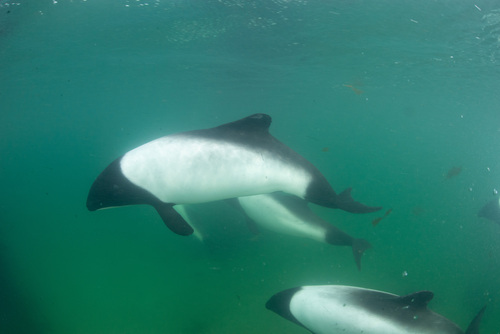
Commerson's Dolphin
Cephalorhynchus commersonii
Meet the 'Panda of the Sea,' a small, high-energy dolphin known for its striking black-and-white patterns and acrobatic displays. These social marine mammals are among the fastest swimmers in their size class and are a favorite for coastal wildlife observers.
Quick Identification
Size
Length: 1.2 to 1.75 metres (3.9 to 5.7 feet); Weight: 35 to 86 kg (77 to 190 lbs)
Colors
Striking black head, dorsal fin, and tail; white body and throat; black 'tear-drop' patch on the belly
Key Features
- Bold black-and-white 'panda' coloration
- Small, stocky build with no distinct beak
- Rounded dorsal fin resembling a Mickey Mouse ear
- Fast, acrobatic swimming style often involving leaps
When You’ll See Them
Geographic range
Where Does the Commerson's Dolphin Live?
Commerson's Dolphin is native to the cold, southern waters of the Atlantic and Pacific oceans, primarily clustered around the tip of South America. They are commonly found along the coastlines of Argentina and Chile, as well as the coastal waters of the Falkland Islands. A secondary, isolated population thrives thousands of miles away in the southern Indian Ocean, specifically inhabiting the shallow waters surrounding the Kerguelen Islands.
Basemap © OpenStreetMap contributors
Behavior
Commerson's Dolphins are famously high-energy cetaceans, often described as the 'gymnasts' of the ocean. They are incredibly fast swimmers, frequently seen riding the bow waves of boats or even the wakes of larger whales. Unlike many other dolphins, they often swim upside down, a behavior believed to help them better visualize prey against the surface or the seafloor while hunting in shallow waters.
These dolphins are highly social and typically travel in small pods of 2 to 10 individuals, though massive aggregations of over 100 have been recorded during feeding frenzies. They have an extremely high metabolism for their size, requiring them to eat roughly 10% of their body weight every day. In their interactions with humans, they are remarkably curious and will often approach vessels to play in the turbulence created by the propellers.
EverydayEarth exclusive
Camera Tips
Capturing Commerson's Dolphin on camera requires speed and patience. If you are setting up a shore-based trail camera or an AI-powered coastal station, aim for a wide-angle view of shallow bays or harbor mouths where they are known to frequent. Because they move so quickly, use a high shutter speed—at least 1/2000th of a second—to freeze their jumps and splashes. A polarizing filter is essential for any coastal camera setup to cut through the water's surface glare and reveal the dolphin’s white body beneath the waves.
For those using AI-powered identification, the black-and-white patterning makes these dolphins ideal candidates for automated detection. Place cameras at an elevated angle on piers or cliffs to get a top-down view of their 'panda' markings. If you are using a waterproof action camera on a pole or buoy, focus on the 'kick' of the tail; Commerson's Dolphins are highly attracted to moving objects and may swim directly toward the lens out of curiosity.
Timing is everything. These dolphins are most active in near-shore areas during rising tides, as the moving water brings in higher concentrations of prey. Set your camera to burst mode or high-frame-rate video. In the early morning or late afternoon, the low sun angle can create harsh shadows on their black skin, so try to capture them during midday when the sun illuminates the white sections of their bodies for the best contrast.
Similar Species
Species that look similar or are commonly confused with Commerson's Dolphin.
Peale's Dolphin
Larger with more complex grey and white flanks and a tall, hooked dorsal fin.
Burmeister's Porpoise
Much shyer and darker in color with a low, triangular dorsal fin set further back on the body.
Orca
Significantly larger with a massive upright dorsal fin and different white patch placement behind the eye.
Frequently Asked Questions
Record Commerson's Dolphin at your habitat
Connect a camera to start building your own species record — AI identifies every visitor automatically.