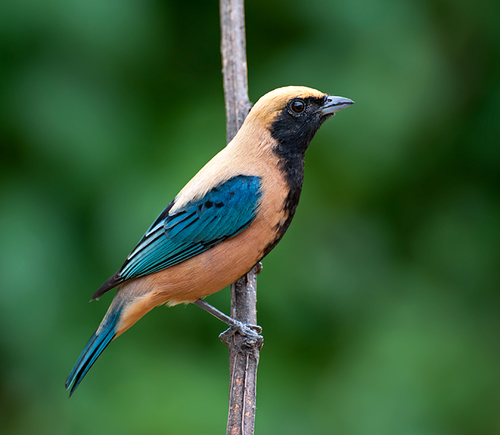
Burnished-buff Tanager
Stilpnia cayana
With its shimmering turquoise throat and warm copper crown, the Burnished-buff Tanager is a crown jewel of South American gardens. This social and adaptable bird brings a splash of tropical brilliance to backyards from Colombia to Argentina.
Quick Identification
Size
Length of 13–14 cm (5.1–5.5 in) and a weight between 18–25 g (0.6–0.9 oz)
Colors
Males display a bright rufous crown, a black facial mask, and a vibrant turquoise-blue throat and chest. Their bodies are a pale burnished-buff or straw color. Females are notably duller with less turquoise and a fainter mask.
Key Features
- Distinctive rufous or copper-colored crown
- Black facial mask through the eyes
- Vibrant turquoise-blue throat and upper breast (males)
- Pale, straw-colored body plumage
When You’ll See Them
Geographic range
Where Does the Burnished-buff Tanager Live?
Native to the South American continent, the Burnished-buff Tanager occupies a vast range that stretches from the northern territories of Colombia, Venezuela, and the Guianas down through central and eastern Brazil. They are also widely distributed across Paraguay, northern Argentina, and eastern regions of Peru and Bolivia. As a species that prefers open landscapes over deep, dense rainforests, they have successfully colonized many human-altered environments across the tropical and subtropical zones of the continent.
Basemap © OpenStreetMap contributors
Behavior
The Burnished-buff Tanager is a restless and highly active songbird, usually seen in pairs or small family groups. They are known for their social nature and are frequent participants in mixed-species foraging flocks, often moving alongside honeycreepers and other tanagers through the canopy and garden shrubbery. They rarely stay still for long, constantly hopping and fluttering as they glean for food.
This species is remarkably well-adapted to human presence, making it a frequent visitor to suburban parks and backyard gardens. While they are not overly aggressive, they are bold enough to frequent bird feeders and water baths even in relatively busy areas. Their vocalizations are thin and high-pitched, consisting of sharp 'tsip' calls used to maintain contact with their partner while moving through dense foliage.
EverydayEarth exclusive
Camera Tips
To successfully capture the Burnished-buff Tanager on your backyard camera, focus your efforts on their primary attractant: fruit. These birds are highly drawn to platform feeders stocked with overripe bananas, halved papayas, or oranges. Place your camera about 5 to 7 feet high, as they prefer feeding at a slight elevation rather than on the ground. To get the best color saturation on their turquoise throats, try to position the feeder in a spot that receives bright, indirect morning sun.
Water is another powerful lure for this species. Burnished-buff Tanagers are enthusiastic bathers and will regularly visit shallow bird baths or water features with a gentle drip. If you are using an AI-powered camera, set it to a high-sensitivity trigger or burst mode. These birds move with quick, jerky motions, and a fast shutter speed is essential to prevent motion blur when they are splashing in the water or hopping between branches.
For the most natural-looking shots, try 'pre-focusing' your camera on a specific 'landing branch' near your feeder. Tanagers often pause on a nearby perch to scan for predators before committing to the feeder. By placing your camera near these natural perches, you can capture candid behavior and the stunning contrast between their rufous crowns and the green foliage. In the warmer months, ensure your camera is shielded from the midday sun to avoid overexposed images of their light-colored, reflective 'buff' feathers.
Similar Species
Species that look similar or are commonly confused with Burnished-buff Tanager.
Frequently Asked Questions
Record Burnished-buff Tanager at your habitat
Connect a camera to start building your own species record — AI identifies every visitor automatically.