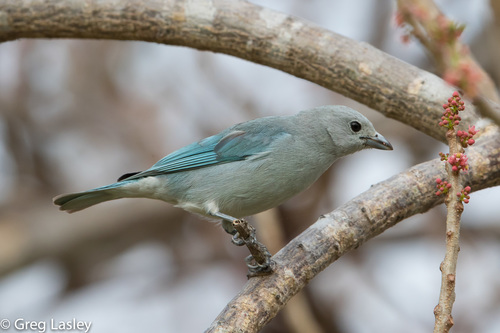
Sayaca Tanager
Thraupis sayaca
The Sayaca Tanager is the elegant 'blue-grey' ghost of South American gardens. A frequent and friendly visitor, this adaptable bird brings a splash of subtle tropical color and lively social energy to any backyard feeder.
Quick Identification
Size
Length: 15-18 cm (6-7 in); Weight: 28-35 g (1-1.2 oz)
Colors
Subtle pale greyish-blue overall with a distinct greenish-blue sheen on the wing and tail feathers; sexes are monomorphic (look identical).
Key Features
- Overall plain greyish-blue plumage
- Greenish-blue sheen on wing and tail feathers
- Black eyes and short, stout grey beak
- Pale underparts with a slight silvery wash
When You’ll See Them
Behavior
The Sayaca Tanager is one of the most social and conspicuous birds in its range, often found in pairs or small family groups. They are incredibly adaptable and have transitioned seamlessly from wild forest edges to bustling urban parks and backyard gardens. Known for their 'chattering' social calls, they are often the first birds to arrive at a freshly stocked fruit feeder, where they may aggressively defend the resource from smaller honeycreepers or finches.
In the wild, they are active foragers that move through the middle and upper layers of the canopy. While they are primarily fruit-eaters, they are opportunistic and will perform acrobatic maneuvers to catch slow-flying insects in mid-air. Their relationship with humans is generally peaceful; they are bold birds that will often tolerate people at a relatively close distance, making them excellent subjects for backyard observation and photography.
EverydayEarth exclusive
Camera Tips
To capture the best footage of a Sayaca Tanager, placement is everything. These birds are 'platform feeders,' meaning they prefer a flat surface over a hanging tube feeder. Mount your AI-powered camera at eye level (roughly 1.5 to 2 meters high) facing a stable wooden platform or a sturdy horizontal branch. If you can position the camera so the morning sun hits the bird from behind the lens, you will significantly enhance the iridescent greenish-blue sheen on their wings, which can otherwise look dull grey in the shade.
Using the right lure is the fastest way to get them on camera. Half-cut bananas or overripe papayas are irresistible to them. Secure the fruit to a branch or feeder using a small skewer to prevent the birds from knocking it out of the camera's frame. Because Sayaca Tanagers are fast movers and often flick their wings while feeding, set your camera to 'Burst Mode' or high-speed video to ensure you catch those crisp, split-second movements without motion blur.
During the warmer months, a birdbath is an equally effective lure. Sayaca Tanagers are frequent bathers and love shallow, moving water. Placing a small solar-powered dripper or fountain in your birdbath will catch their attention from the canopy. Position your camera about 1 meter away from the water's edge at a slightly downward angle to capture the dramatic splashing and feather-preening behavior.
Lastly, pay attention to the background. Since these birds are a soft grey-blue, they can easily blend into a grey sky or a concrete wall. Aim your camera toward a backdrop of lush green foliage. This contrast not only makes the bird 'pop' in the frame but also provides the AI with a clearer silhouette for more accurate species identification. If your camera allows for sensitivity adjustments, set it to medium-high during the early morning hours when these birds are most active and lighting is still soft.
Similar Species
Species that look similar or are commonly confused with Sayaca Tanager.
Frequently Asked Questions
Record Sayaca Tanager at your habitat
Connect a camera to start building your own species record — AI identifies every visitor automatically.