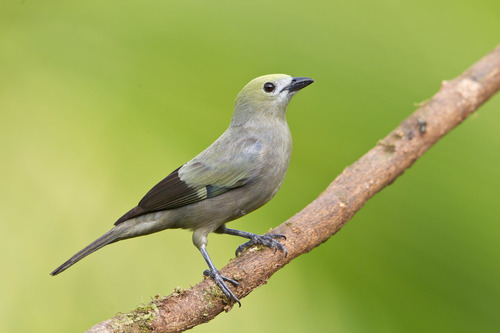
Palm Tanager
Thraupis palmarum
Meet the subtle acrobat of the tropical garden. The Palm Tanager may lack flashy colors, but it makes up for it with its lively personality and impressive aerial maneuvers among the palm fronds.
Quick Identification
Size
18–19 cm (7–7.5 in) in length; weighs 32–45 g (1.1–1.6 oz)
Colors
Dull olive-green to brownish-grey plumage; darker flight feathers and tail; distinctive yellowish-white wing bar visible in flight
Key Features
- Dull olive-green or grayish body plumage
- Distinct yellowish-white wing bar visible during flight
- Slightly forked tail and acrobatic movement
- Medium-sized with a stout, dark bill
When You’ll See Them
Sightings on EverydayEarth
Jul 31, 2026
A Palm Tanager is perched on the right side of the feeder tray, occasionally pecking at the fruit. Later, a female Thick-billed Euphonia flies in and lands nearby to feed on the fruit as well.
Jul 30, 2026
A Palm Tanager is perched on the right side of the fruit feeder, hopping between pieces of citrus and banana to feed. A second bird is briefly visible on the far left edge of the tray at the beginning of the clip before it moves out of view.
Jul 29, 2026
A Palm Tanager is perched on the fruit tray, feeding on sliced oranges and bananas. About eleven seconds into the video, a male Crimson-backed Tanager lands on the left side of the tray to join the feast.
Jul 28, 2026
A variety of tropical birds, including Blue-gray Tanagers, a Bananaquit, and a Palm Tanager, are seen feeding on an assortment of fruit at the platform. A Clay-colored Thrush remains stationary on a nearby branch. The peaceful feeding session is interrupted when a Red-tailed Squirrel suddenly vaults onto the tray from below, causing the birds to quickly take flight as the squirrel begins to inspect the fruit.
Jul 25, 2026
A Palm Tanager lands on the feeder tray and begins to feed on the slices of banana and citrus. Shortly after, a Blue-gray Tanager lands on the far left edge of the platform before quickly moving out of the frame.
Jul 25, 2026
A group of tropical birds gathers at a fruit feeder platform. A Clay-colored Thrush and a Palm Tanager are already present when a male Crimson-backed Tanager arrives from the lower left. The birds actively feed on halved oranges and papaya, hopping between pieces of fruit and occasionally looking around at the lush jungle surroundings.
Behavior
The Palm Tanager is a lively and social bird, often seen in the company of its close relative, the Blue-gray Tanager. Despite its understated coloration, it is far from shy. They are known for their restless energy, constantly flitting between palm fronds or garden shrubs in search of food. Their social structure is informal, often forming loose flocks that move through suburban neighborhoods and forest edges with a noisy, chirping chatter.
In human-dominated landscapes, they have adapted remarkably well. They are frequent visitors to bird feeders and garden fruit trees, showing little fear of people. You’ll often find them performing impressive acrobatic feats, hanging upside down from palm leaves to glean insects or pluck small berries. Their presence is usually announced by a sharp, high-pitched 'seee' call as they transition between trees.
EverydayEarth exclusive
Camera Tips
To capture the best footage of Palm Tanagers, focus your camera on elevated feeding stations rather than the ground. These birds are arboreal by nature and prefer to stay at eye level or higher. If you have palm trees on your property, aim your camera specifically at the base of the fronds or near clusters of ripening palm fruit, as this is where they spend the majority of their time foraging. A mounting height of 5 to 8 feet is usually ideal for getting clear, eye-level shots as they land on feeders or branches.
Baiting is highly effective for this species. Offer overripe bananas, halved papayas, or oranges on a platform feeder. Because they are social and often travel in pairs or small groups, a wide-angle lens setting is recommended to capture multiple birds at once. Since they are fast-moving and rarely stay still for long, set your AI-powered camera to a high trigger speed or use a 'burst' photo mode to ensure you catch the moment they land before they dart off again. If your camera supports video, 30-second clips are perfect for capturing their restless, acrobatic feeding style.
Lighting is crucial because of their subtle olive-green coloring, which can easily look washed out or like a dark silhouette in deep shadows. Position your camera with the sun at your back to illuminate the yellowish wing bars and the olive sheen of their feathers. Early morning light (the first three hours after sunrise) provides the best 'golden hour' contrast. In suburban backyards, look for 'perch-and-wait' spots—thin branches near a water source or feeder where they often pause for a few seconds to scan the area before approaching.
Similar Species
Species that look similar or are commonly confused with Palm Tanager.
Frequently Asked Questions
Record Palm Tanager at your habitat
Connect a camera to start building your own species record — AI identifies every visitor automatically.