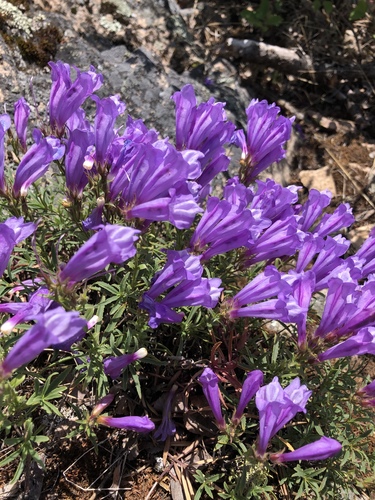
Bush Penstemon
Penstemon fruticosus
A resilient mountain beauty that brings a splash of purple to the Pacific Northwest’s rocky terrains. This woody perennial is a favorite for high-altitude pollinators and rock garden enthusiasts alike.
Quick Identification
Size
A low-growing subshrub typically reaching 15–40 cm (6–16 inches) in height with a spread of up to 60–90 cm (24–36 inches).
Colors
Showy tubular flowers in shades of lavender, blue-purple, or light pink; foliage is a deep, leathery green that can turn reddish in winter.
Key Features
- Large tubular flowers with a distinct 'bearded' sterile stamen
- Woody base with a spreading, mat-forming growth habit
- Leathery, serrated leaves that remain semi-evergreen
When You’ll See Them
Geographic range
Where Does the Bush Penstemon Live?
The Bush Penstemon is a quintessential native of the North American Pacific Northwest. Its primary range extends from the interior mountains of British Columbia and Alberta in Canada southward into Washington, Oregon, Idaho, and western Montana. It is most commonly found in the Cascades and Northern Rockies, thriving in the rugged terrain where few other flowering shrubs can gain a foothold.
Basemap © OpenStreetMap contributors
Behavior
Bush Penstemon is a hardy, woody-based perennial that functions as a cornerstone of the Pacific Northwest’s rocky ecosystems. Unlike many herbaceous wildflowers, it maintains a permanent structure of stems, slowly spreading to form dense mats that help stabilize soil on steep, rocky slopes. During the peak of spring and early summer, it erupts into a profusion of blooms that act as a primary fuel station for high-altitude pollinators.
This species is specifically adapted to survive in harsh, well-drained environments where other plants struggle. It interacts heavily with local wildlife; its tubular blossoms are perfectly shaped for the long bills of hummingbirds and the specialized tongues of bumblebees. While it doesn't 'behave' in the animal sense, its growth pattern is one of resilience, often wedging itself into rock crevices to escape the heat and wind.
EverydayEarth exclusive
Camera Tips
To capture the true beauty of the Bush Penstemon, you should treat it as a stage for wildlife. Set up your AI camera on a tripod at a low angle, roughly 12 to 18 inches off the ground, to align with the height of the flower clusters. Because these plants often grow in bright, exposed areas, ensure your camera has a high dynamic range (HDR) setting enabled to prevent the vibrant lavender petals from 'blowing out' in the midday sun.
If your goal is to capture the pollinators that frequent this species, use a fast shutter speed or a 'burst' trigger mode. Hummingbirds and clearwing moths are common visitors that move with incredible speed. Position the camera about 2–3 feet away from a particularly dense cluster of blooms; this distance allows for a wide enough frame to catch birds entering the shot while maintaining enough detail to see the fine hairs inside the Penstemon's throat.
For a unique perspective, try a long-term time-lapse during the late spring. By taking one photo every hour for two weeks, you can capture the dramatic transition as the woody stems transform from green buds into a sea of purple blossoms. If you are placing a camera in a backyard setting, avoid using heavy baits near the plant, as you want to encourage natural pollinator visits without attracting larger mammals that might inadvertently crush the delicate woody stems.
Similar Species
Species that look similar or are commonly confused with Bush Penstemon.
Frequently Asked Questions
Record Bush Penstemon at your habitat
Connect a camera to start building your own species record — AI identifies every visitor automatically.