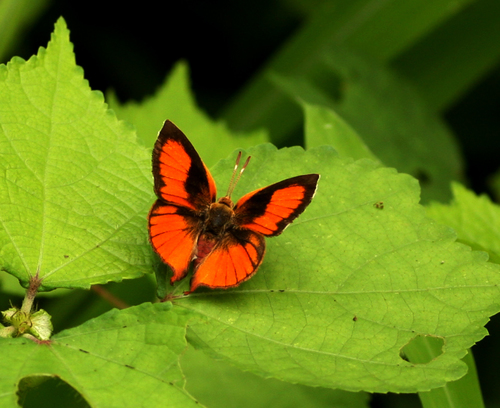
Bush Scarlet
Axiocerses amanga
A flash of brilliant crimson in the African sun, the Bush Scarlet is one of the savanna's most striking small butterflies. With its intricate silver-spotted underside and bold territorial nature, it is a favorite for backyard naturalists and photographers across the continent.
Quick Identification
Size
Wingspan of 24–30 mm (0.9–1.2 inches)
Colors
Brilliant scarlet-red upperside with dark brown/black borders; underside is a complex mottled pattern of reddish-brown, cream, and silver-white spots.
Key Features
- Brilliant scarlet upperside with dark margins
- Intricate silver-white spotting on the reddish-brown underside
- Small, delicate tails on the hindwings
- Fast, erratic flight pattern when disturbed
When You’ll See Them
Geographic range
Where Does the Bush Scarlet Live?
The Bush Scarlet is a quintessential African butterfly, native to a massive swathe of Sub-Saharan Africa. Its core range stretches from South Africa and Namibia in the south, northward through Zimbabwe, Botswana, and Mozambique, and up into East Africa, including Kenya and Ethiopia. While it is a true native of the continent, its adaptability allows it to flourish wherever its host acacia trees are present, making it a common sight in both wild bushveld and well-planted suburban landscapes.
Basemap © OpenStreetMap contributors
Behavior
Unlike many butterfly species that prefer the safety of dense shade, the Bush Scarlet thrives in the warm, open light of the savanna. They spend a significant portion of their day 'mud-puddling'—gathering at moist soil patches to extract minerals—or visiting flowering shrubs to feed on nectar. While they are wary of sudden movements, they can be surprisingly approachable once they have settled on a favorite perching spot.
EverydayEarth exclusive
Camera Tips
Capturing the Bush Scarlet on an AI-powered camera requires a focus on their favorite perching spots. These butterflies are creatures of habit; look for a sunny bush, particularly an Acacia or a flowering shrub, that sits at the edge of a clearing. Mount your camera approximately 1 to 1.5 meters (3-5 feet) off the ground, angled slightly downward toward the tops of the outer branches where males like to establish their territories. Because they are small and fast, a high-speed trigger or a 'near-focus' macro lens setting is essential to prevent motion blur and capture the fine details of their wings.
To increase your chances of a close-up, consider a 'natural lure' strategy. Place your camera near a patch of mud or a shallow water source during the hotter parts of the day. Bush Scarlets are frequent mud-puddlers, and they will stay still for much longer while drinking than they do while feeding on flowers. If you have a backyard garden, positioning the camera near nectar-rich plants like Buddleja or Lantana can provide consistent traffic throughout the morning hours.
Lighting is your biggest challenge and your greatest ally. To capture the true scarlet of their wings, you want bright, direct sunlight. However, harsh midday sun can wash out the silver details on the underside. Aim for a camera position that receives 'golden hour' light in the late afternoon. If your camera has adjustable settings, a fast shutter speed (1/1000s or higher) is recommended to freeze the wing movement, as even when perched, they tend to vibrate their wings slightly to regulate their body temperature.
Similar Species
Species that look similar or are commonly confused with Bush Scarlet.
Common Scarlet
The Common Scarlet lacks the intense, bright silver-white spotting on the underside of the wings that characterizes the Bush Scarlet.
Eastern Scarlet
Found primarily in coastal forests, the Eastern Scarlet has broader black margins on the upperside and a different configuration of underside markings.
Frequently Asked Questions
Record Bush Scarlet at your habitat
Connect a camera to start building your own species record — AI identifies every visitor automatically.